Title: How to Ask for a Spot at the Gym (And Do It Right)
You have followed your progressive overload program perfectly for the last six weeks. You are lying on the bench press, staring up at a weight you have never attempted before. You know you have the strength, but the psychological fear of getting pinned under a heavy barbell is holding you back.
You need a spotter. But looking around a crowded gym floor and asking a stranger for help can trigger massive anxiety, especially if you are relatively new to the iron game.
The fitness industry often portrays gyms as hyper-individualistic environments where everyone is wearing headphones and ignoring each other. While focus is critical, the reality of a true strength facility is very different. In a serious gym, spotting is a sacred social contract. If you respect the iron, experienced lifters will almost always respect your effort and gladly help you out.
At Tulsa Fitness Club (TFC) in the historic Blue Dome District, we actively cultivate a culture of mutual respect and hard work. If you want to know how to ask for a spot at the gym without feeling awkward or looking like a rookie, here is the definitive, no-nonsense guide to the unwritten rules of the training floor.
The Unwritten Rules of Asking
Before you communicate how you want to be spotted, you have to know who and when to ask. Navigating the social flow of the gym requires spatial awareness and respect for other people’s training blocks.
- Rule 1: Don’t Ask Mid-Set. Never approach someone while they are actively lifting, and do not hover two feet away from them while they finish a heavy set. Wait until they have racked their weight and are clearly resting.
- Rule 2: Size Doesn’t Always Matter. You do not need to find the biggest bodybuilder in the gym to spot your 185-pound bench press. A spotter isn’t there to deadlift the weight for you; they are there to provide 5 to 10 pounds of upward assistance if you fail. Look for someone who looks focused and experienced, regardless of their size.
- Rule 3: The Headphone Wave. If someone is wearing over-ear headphones, they are in the zone. However, if they are the only person nearby, it is acceptable to ask for a spot. Stand in their line of sight and give a small, polite wave. When they take an ear cup off, simply ask, “Hey, mind giving me a quick spot?”
1
The Communication Protocol
Eliminate the guesswork
The worst spots happen when the lifter and the spotter have two different plans. Before you lie down on the bench, you must establish the rules of engagement.
- Target Reps: “I’m going for 4 or 5 reps.” This tells the spotter when to expect fatigue.
- The Lift-Off: “I don’t need a lift-off” OR “Give me a lift-off on three. One, two, three.” (A lift-off is when the spotter helps you unrack the bar so your shoulders stay packed).
- The Touch Rule: “Please don’t touch the bar unless it actually starts moving downward.” (This prevents an overeager spotter from grabbing the bar and ruining your set just because your bar speed slowed down).
Generating interactive visual…Structuring code, this may take a minute
Spotting Mechanics: What to Expect
When you ask for a spot, it helps to know what a good spot actually looks like, so you can communicate if they are doing it wrong.
The Barbell Bench Press
The spotter should stand directly behind your head. If you ask for a lift-off, they should use an alternating grip (one hand over, one hand under) to help you smoothly move the bar over your chest, then release it entirely. They should keep their hands hovering near (but not touching) the bar during your set. If the bar stops moving upward and begins to sink, they should grab the bar with the alternating grip and help you guide it back to the J-hooks.
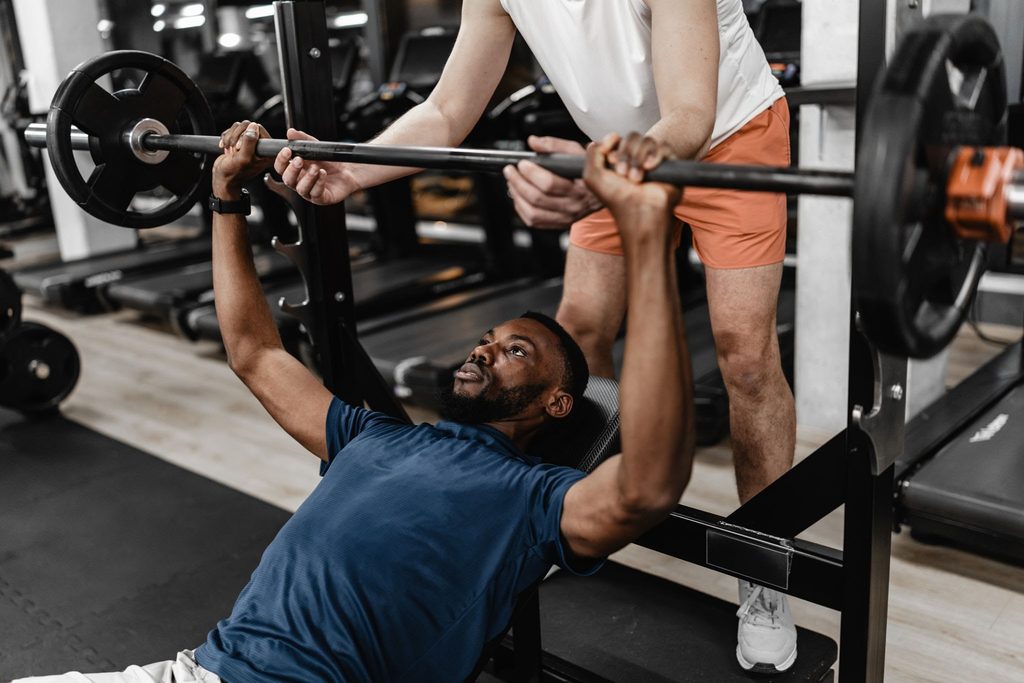
A good bench press spotter hovers their hands near the bar but respects the ‘touch rule’—never assisting until the bar actually stalls or moves downward.. Source: Authentic Source / Getty Images
The Heavy Dumbbell Press
This is where many beginners make a massive mistake. A spotter should always spot your wrists, never your elbows.If they push up on your elbows and your grip fails, 100-pound dumbbells will crash directly onto your chest or face. By guiding your wrists, they control the actual weight.
The Barbell Back Squat
Squat spotting is inherently awkward, which is why safety pins are preferred (more on that below). If you must be spotted on a squat, the spotter stands directly behind you. If you fail in the hole, they hook their arms firmly under your armpits (across your chest) and squat with you, using their legs to help drive your torso upward. They do not grab the barbell.
Generating interactive visual…Preparing high-resolution details
Key insight: When you are spotted correctly on a squat, the spotter acts as a secondary core, stabilizing your torso so you can use your remaining leg strength to finish the rep.
The TFC Environment: Engineered for Safety and Autonomy
While knowing how to ask for a spot is a crucial gym skill, your physical safety shouldn’t entirely depend on whether a stranger happens to be standing nearby.
Commercial gyms often lack adequate safety equipment, forcing you to rely on spotters for almost every heavy set. At Tulsa Fitness Club, we actively engineered our facility so you can push your absolute limits safely, even if you are training completely alone at 3:00 AM.
Equipment Built for Autonomy
We prioritize heavy-duty power racks equipped with adjustable safety pins and safety straps.
If you are executing a heavy Barbell Back Squat or a Barbell Bench Press inside a TFC power rack, you simply set the safety pins one inch below your lowest active range of motion. If you fail the lift, you do not need a spotter—you simply lower the bar onto the steel pins and slide out safely. We provide the elite iron necessary for you to be entirely self-reliant.
A Culture of Respect
When you do want a spotter—perhaps for a heavy dumbbell press where safety pins cannot help you—TFC provides the perfect environment. Because we are a dedicated 24/7 strength facility, our floor is populated by focused, experienced lifters. The chaotic “gym creep” behavior of commercial clubs doesn’t survive here. If you ask a TFC member for a spot, you will get a professional, respectful lift-off every single time.
Built-In Coaching: Never Guess Again
If you are tired of relying on strangers to guide your progress, we integrated elite coaching directly into our memberships.
- Bronze Tier ($47/mo — Presale $37/mo): Unrestricted 24/7 access to our heavy power racks and safety equipment. The perfect tier for the independent lifter who knows how to utilize safety pins and ask for a spot when needed.
- Silver Tier ($97/mo): 24/7 access plus periodized programming templates. We tell you exactly what weights to hit, removing the guesswork so you know exactly when you will be pushing close to failure.
- Gold Tier ($297/mo): The ultimate coaching replacement. Full access and premium coaching check-ins. You can record your heavy lifts, and a professional TFC strength coach will review your form, ensuring your mechanics are so locked in that you rarely fail a lift in the first place.
The Presale Advantage: Right now, you can lock in our Founding Member Presale Rate starting at just $37/month(with your first month for only $1).
With the upcoming integration of our Catalyst Coworking space and Fuel Bar, TFC is rapidly becoming the ultimate off-site location for downtown professionals. You can execute a heavy, safe lifting session in our power racks, grab a high-protein recovery shake, and transition immediately into our secure Wi-Fi lounge.
Stop letting the fear of a heavy barbell cap your progress. Learn the protocol, use the safety pins, and train in a facility that respects the iron.
Call us at 918-550-5549 or drop by 314 E 3rd St., Tulsa, OK 74120 during staffed hours to tour the facility, pick up your secure 24/7 key fob, and lock in your Founding Member pricing before the presale ends.