Gym Exercise Substitutions: What to Do When Equipment Is Unavailable
You walk into the gym at 5:30 PM on a Tuesday. Your spreadsheet says today is a heavy lower-body day, and your first primary movement is the barbell back squat. You are focused, caffeinated, and ready to apply progressive overload.
But as you look across the sprawling, 40,000-square-foot commercial facility, your heart sinks. The gym has 80 treadmills, but only two power racks. One rack is occupied by someone doing barbell bicep curls. The other rack is occupied by a group of three teenagers who are spending 10 minutes checking their phones between every single set.
You have a choice to make. Do you stand there for 30 minutes, letting your heart rate drop and your central nervous system cool down while you wait for the equipment? Or do you pivot, substitute the exercise, and keep your workout moving?
If you are searching for gym exercise substitutions because you are tired of having your routine derailed by crowds, you need a system. The fitness industry often treats exercise selection like a rigid recipe—if you are missing one ingredient, the whole workout is ruined.
At Tulsa Fitness Club (TFC) in the historic Blue Dome District, we believe that an athlete should never be at the mercy of a crowded floor. While our facility is specifically designed to eliminate these bottlenecks, it is still critical to know how to adapt when you travel or train in sub-optimal environments.
If your primary equipment is taken, here is the brutally honest, science-backed guide to swapping exercises without sacrificing your mechanical tension, your muscle growth, or your time.
The Core Principle: Movement Patterns Over Muscles
The biggest mistake beginners make when trying to substitute an exercise is thinking in terms of isolated muscle groups. If the bench press is taken, they wander over to the cable crossover machine or the pec deck because those machines “work the chest.”
While those machines do target the pectoral muscles, they are isolation movements. They do not recruit the heavy central nervous system drive, core stability, or tricep activation that a heavy compound bench press requires. You are downgrading your workout from a massive systemic stressor to a light accessory movement.
To substitute correctly, you must think in terms of Movement Patterns.
Your brain does not know what a “barbell” or a “cable” is. It only understands biomechanical tension across specific joints. Human strength training can be distilled into six primary movement patterns. If you swap an exercise within the exact same movement pattern, your body will adapt just as effectively.
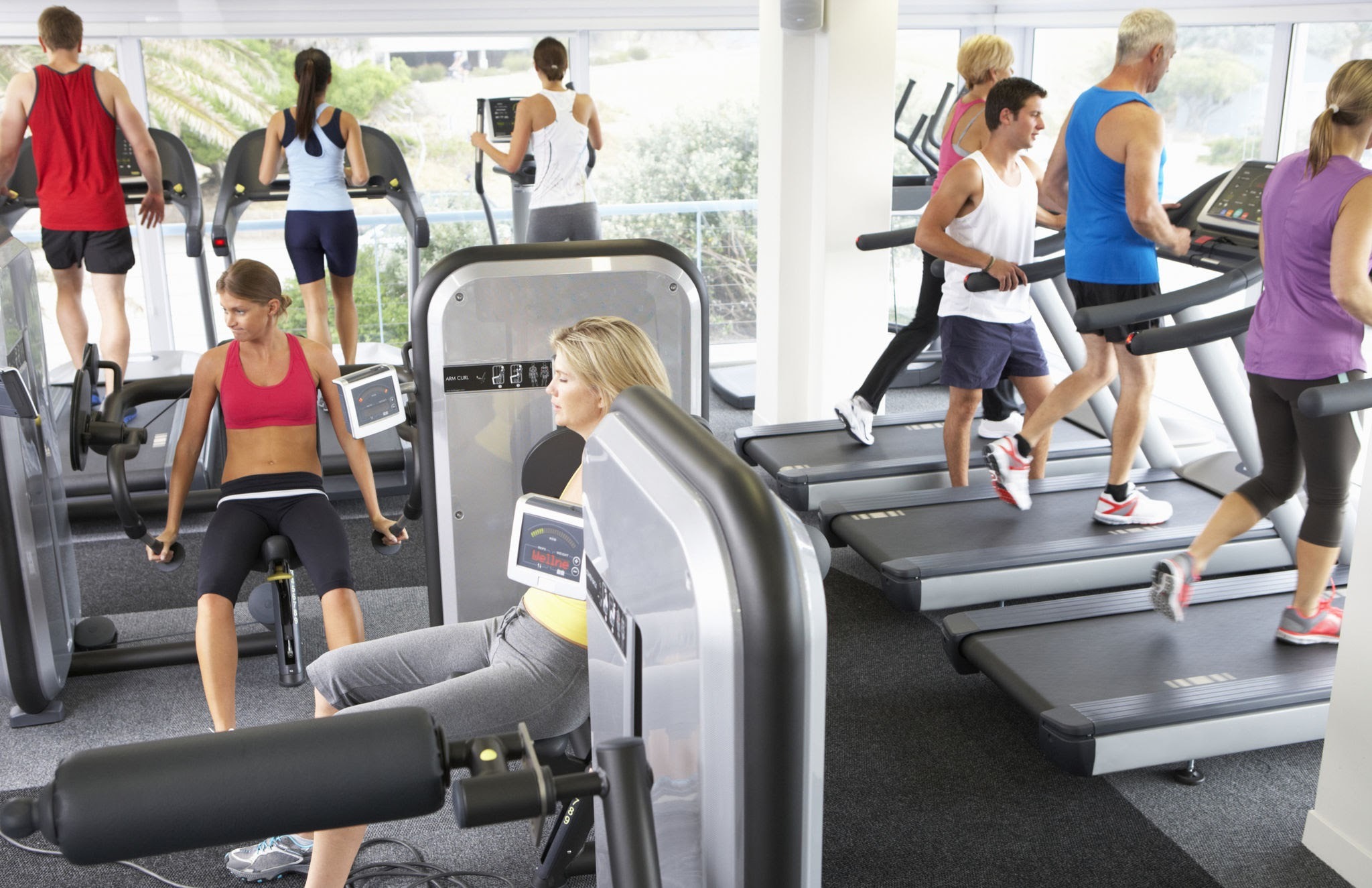
The classic commercial gym bottleneck: an abundance of cardio equipment but a severe lack of heavy free weights and power racks during peak hours.. Source: monkeybusinessimages / Getty Images
The Substitution Blueprint for the “Big Four”
When you are mapping out your gym exercise substitutions, you need to know exactly which alternative will provide the closest mechanical tension to your primary lift. Here are the professional workarounds for the four most commonly bottlenecked exercises on a commercial gym floor.
1. The Squat Pattern (Knee Dominant)
The squat is a bilateral, knee-dominant movement that heavily recruits the quadriceps, glutes, and core. If both squat racks are occupied, do not default to the leg extension machine. You need a movement that requires balance and deep hip flexion.
- Top Substitute: The Dumbbell Goblet Squat. Hold a heavy dumbbell vertically against your chest. This forces your torso to remain upright, perfectly mimicking a front squat while heavily engaging your core.
- The Unilateral Upgrade: Bulgarian Split Squats. If the gym doesn’t have dumbbells heavy enough to challenge you on a goblet squat, switch to one leg. Elevate your rear foot on a bench and hold moderate dumbbells in each hand. Because you are lifting your entire body weight plus the dumbbells on a single leg, the mechanical tension on that quad is massive.
2. The Hinge Pattern (Hip Dominant)
The conventional deadlift or Romanian deadlift (RDL) relies on pushing the hips backward to load the hamstrings and glutes, while the spinal erectors stabilize the back.
- Top Substitute: Dumbbell Romanian Deadlifts. Grab the heaviest dumbbells you can hold. Push your hips back exactly as you would with a barbell. The advantage here is that dumbbells allow for a slightly more natural arm path at your sides.
- The Power Sub: Heavy Kettlebell Swings. If you were planning to do dynamic, explosive deadlifts but have no barbell, a heavy kettlebell swing replicates that explosive hip extension perfectly.
3. The Horizontal Push Pattern
The flat barbell bench press is the king of horizontal pushing, recruiting the chest, anterior deltoids, and triceps. Waiting for a bench on a Monday evening is a universal point of frustration.
- Top Substitute: Flat Dumbbell Bench Press. This is arguably not even a substitute; many strength coaches consider it superior to the barbell for hypertrophy because it allows for a deeper stretch at the bottom of the movement and independent arm stabilization.
- The Bodyweight Sub: Weighted Push-Ups or Dips. If every bench is taken, grab a 45-pound plate, ask a friend to place it on your mid-back (or use a dip belt), and execute deep, controlled push-ups or parallel bar dips.
4. The Vertical Pull Pattern
If your program calls for heavy lat pulldowns or assisted pull-ups, and the cable towers are completely swarmed, you need a movement that drives the elbows down toward the hips.
- Top Substitute: The Pull-Up. Find any open pull-up bar (often attached to the top of a cable crossover machine or a power rack). If you cannot do bodyweight pull-ups, drape a heavy resistance band over the bar, step your foot into it, and perform band-assisted pull-ups.
- The Angle Shift: Heavy Dumbbell Pullovers. Lie perpendicular across a bench, holding a single heavy dumbbell with both hands. Lower it behind your head and pull it back over your chest. This heavily engages the lats without requiring a cable stack.
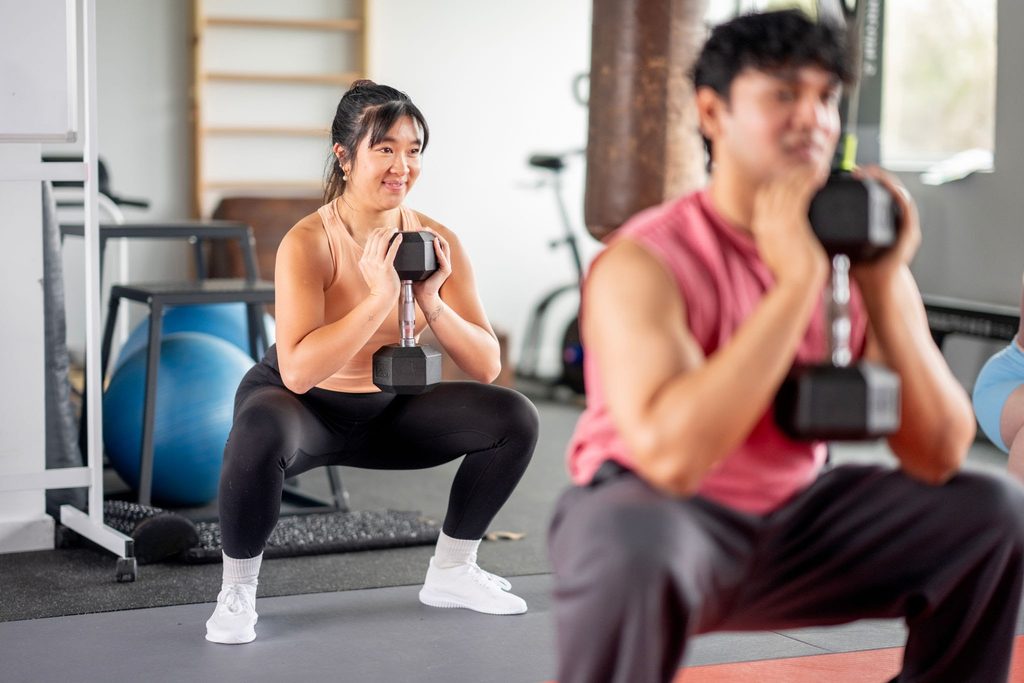
The Dumbbell Goblet Squat is one of the most powerful and versatile squat pattern substitutes available when the barbells are taken.. Source: FatCamera / Getty Images
When the Dumbbells Are Maxed Out (The Intensity Trick)
The most common problem with using dumbbells as a substitute in a commercial gym is the “dumbbell ceiling.” If you normally barbell squat 225 pounds, but the gym’s dumbbells stop at 75 pounds, grabbing a 75-pound dumbbell for a goblet squat isn’t going to provide enough mechanical tension to trigger muscle growth.
When your equipment is too light, you must manipulate Time Under Tension (TUT) to make the lighter weight feel significantly heavier.
1
Use Pause Reps
Eliminate the bounce
Instead of squatting down and immediately bouncing back up, pause at the absolute bottom of the movement for three full seconds. This eliminates the stretch reflex in your tendons and forces your muscles to do 100% of the work to initiate the concentric (upward) phase. A 75-pound goblet squat with a 3-second pause will humble you quickly.
2
Slow the Eccentric Phase
Control the descent
Take a full 4 to 5 seconds to lower the weight, then explode up in one second. The eccentric (lowering) phase causes the most muscle damage required for hypertrophy. Slowing it down drastically increases the difficulty of lighter weights.
3
Change the Exercise Order
Pre-exhaustion
If you know the dumbbells are too light for your squats, do your heavy hamstring curls or leg extensions first. By pre-exhausting the surrounding musculature, that lighter 75-pound dumbbell will feel like 150 pounds when you finally get to the squat pattern.
Generating interactive visual…Structuring code, this may take a minute
The TFC Solution: Eliminating the Bottleneck Entirely
Knowing how to substitute exercises is a vital skill for any serious lifter. But let’s be honest: you shouldn’t have to rewrite your entire workout program every single Monday just because your gym failed to purchase enough equipment.
If you are paying a monthly membership fee, you deserve access to the tools you need to execute your plan.
At Tulsa Fitness Club, we looked at the massive bottlenecks occurring in commercial mega-gyms and actively engineered them out of our facility. We didn’t waste our floor space on 50 ellipticals. We built an iron sanctuary designed specifically to support heavy, structured lifting.
Equipment Ratios That Respect Your Time
We prioritize the exact equipment that causes traffic jams at other gyms. When you walk into TFC, you will find multiple heavy-duty power racks, dedicated deadlift platforms equipped with competition bumper plates, and a massive array of heavy hex dumbbells that scale far beyond the 75-pound commercial limit.
When your program calls for a barbell squat, you walk up and you squat. You don’t have to substitute it for a dumbbell variation unless you explicitly want to.
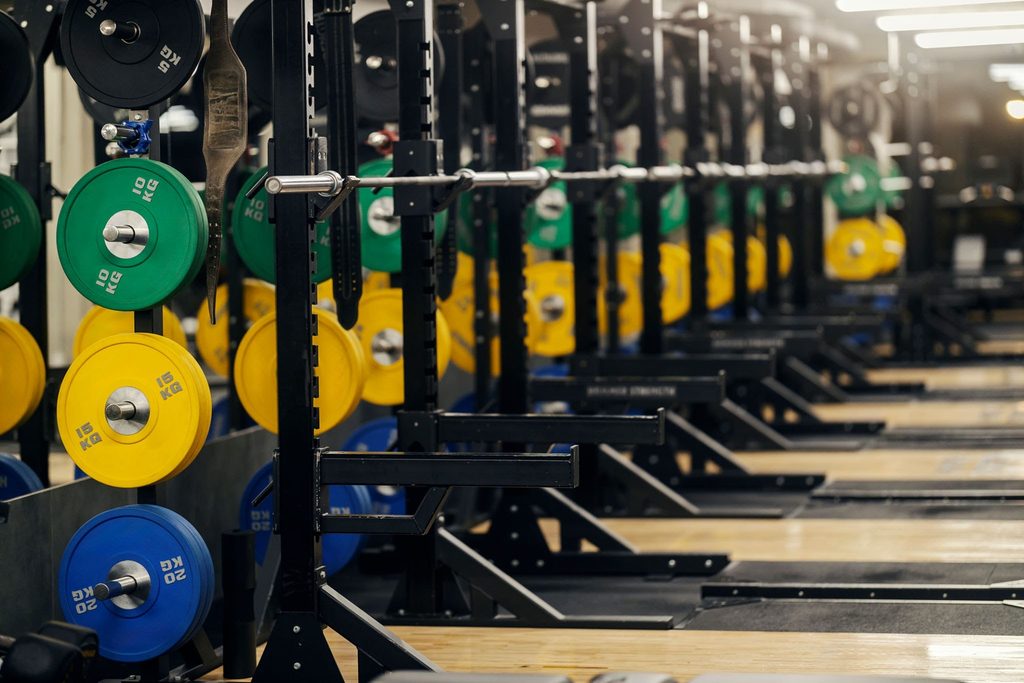
At TFC, we prioritize multiple heavy-duty power racks so you can execute your primary compound lifts without constantly being forced to substitute your exercises.. Source: Organic Media / Getty Images
Unrestricted 24/7 Access
The fastest way to avoid a crowded floor is to train when no one else is awake. While commercial health clubs lock their doors at 10:00 PM, TFC operates on an unrestricted 24/7 model. Your encrypted digital key fob grants you immediate access 365 days a year. If you want the entire gym to yourself at 3:00 AM, the iron is always waiting for you.
Key insight: A great workout plan is useless if your environment actively prevents you from executing it. Don’t let a poorly equipped commercial gym dictate your physical progress.
Upgrade Your Environment, Not Just Your Exercises
You now have the playbook for gym exercise substitutions. But if you find yourself using it every single day, it is time to reassess where you train.
Tulsa Fitness Club offers transparent, flat-rate tiers designed to support your progress without the corporate fluff:
- Bronze Tier ($47/mo — Presale $37/mo): Unrestricted 24/7 access to our heavy iron. Bring your own routine and execute it without waiting in line.
- Silver Tier ($97/mo): 24/7 access plus expertly designed programming templates that detail exactly what to do, including built-in, approved substitute exercises for variety.
- Gold Tier ($297/mo): The ultimate coaching experience. Full access, premium coaching check-ins, and highly customized programming. If you travel and only have a hotel gym, your TFC coach will rewrite your program on the fly with the exact substitutions you need.
The Presale Advantage: Right now, you can lock in our Founding Member Presale Rate starting at just $37/month(with your first month for only $1).
With the upcoming integration of our Catalyst Coworking space and Fuel Bar, TFC is rapidly becoming the ultimate off-site location for downtown professionals. You can crush your primary lifts on world-class equipment, grab a protein shake, and seamlessly transition into deep-focus work in our secure Wi-Fi lounge.
Stop settling for suboptimal workouts. Call us at 918-550-5549 or drop by 314 E 3rd St., Tulsa, OK 74120 during staffed hours to tour the facility, pick up your key fob, and lock in your membership before the presale ends. No contracts. No hidden fees. Just the equipment you need to build real strength.