Title: How Long Should You Follow a Workout Plan Before Changing It?
Walk into any commercial fitness center, and you will inevitably hear someone talking about “muscle confusion.” They will brag about how they never do the same workout twice, constantly switching from kettlebells to cable machines, and from 5-rep heavy sets to 20-rep burnout circuits, all in a desperate attempt to keep their body guessing.
The modern fitness industry loves a fresh routine. Influencers need new content, apps need to sell you new templates, and magazines need a new “30-Day Shred” for every cover. Because of this constant bombardment of novelty, beginners frequently ask: how long to follow a workout plan before it stops working?
If you change your workout every two weeks, you are not confusing your muscles; you are confusing yourself.
At Tulsa Fitness Club (TFC), located in the historic Blue Dome District, we despise the endless cycle of novelty. Building genuine strength is not about entertaining your central nervous system—it is about systematically forcing adaptation.
If you are tired of spinning your wheels and feeling sore without actually getting stronger, here is the brutally honest, science-backed truth about how long you should actually stick to a program, when to take a deload, and how to spot a genuine plateau.
The “Muscle Confusion” Myth Exposed
To understand why you need to stick to a plan, you first have to understand why “muscle confusion” is biological nonsense.
Your muscles do not have a cognitive brain. They do not get “bored” of barbell squats. They only respond to one thing: mechanical tension.
When you introduce a completely new exercise (like a barbell back squat) to a beginner, the first few weeks of progress are almost entirely neurological. Your brain is simply learning how to coordinate muscle fibers to balance the weight efficiently. This is why a beginner can add 10 pounds to the bar every session for the first month.
If you change the exercise in week three because you read an article about “muscle confusion,” you are throwing away that neurological efficiency just as your body is preparing to actually build new muscle tissue. You force your brain to start from scratch, constantly learning new movements without ever applying the heavy mechanical tension required to trigger hypertrophy.

Real progress comes from mastering the foundational compound movements like the barbell squat over months, not by swapping them out every two weeks.. Source: Cardio Online Superstore
The Optimal Window: 6 to 12 Weeks
So, how long should you follow a workout plan? In the strength and conditioning world, training is broken down into structured blocks called “mesocycles.”
For the vast majority of lifters—from rank beginners to seasoned intermediates—a well-designed mesocycle lasts between 6 and 12 weeks.
This 6-to-12-week review window is not an arbitrary expiration date; it is the biological timeframe required to see genuine adaptation.
Why 6 to 12 Weeks Works
1
The Neurological Phase
Weeks 1-3
You learn the mechanics of the specific lifts in your program. Your central nervous system figures out how to fire the correct muscle fibers simultaneously. You aren’t building massive amounts of muscle yet; you are just getting efficient.
2
The Hypertrophy Phase
Weeks 4-8
Now that your form is locked in, you can start pushing heavier loads closer to muscular failure. This is where the actual mechanical tension occurs, and where the physiological muscle growth begins in earnest.
3
The Accumulation Phase
Weeks 9-12
You are lifting significantly heavier weight than you were in Week 1. Fatigue is accumulating, but you are hitting personal records. By the end of this block, you will likely need a structured “deload” week to allow your joints and nervous system to recover fully.
If you abandon ship at Week 4, you are quitting exactly when the real biological returns begin to compound.
Generating interactive visual…Structuring code, this may take a minute
4 Legitimate Reasons to Change Your Program
Just because you shouldn’t change your program every two weeks doesn’t mean you should run the exact same routine for five years. Eventually, you will need a new stimulus.
Do not change your program out of boredom. Change your program when the biological data demands it. Here are the four legitimate triggers for an overhaul:
Iron Man Magazine
1. You Have Hit a True Plateau
A plateau does not mean you had one bad workout where the barbell felt heavy. A true plateau means you have failed to add weight, reps, or volume to a specific lift for three consecutive weeks, despite eating in a caloric surplus and sleeping eight hours a night. If your bench press has been stuck at 185 pounds for a month, it is time to change the rep scheme or rotate to a different pressing variation to attack the weak point.
2. The Routine Causes Chronic Pain
Normal muscle soreness (DOMS) is a standard part of lifting. Sharp, chronic joint pain is not. If barbell back squats repeatedly cause severe lower back or knee pain despite relentless form correction, you should not stubbornly grind through it. You rotate the exercise—perhaps to a Safety Squat Bar or a Hack Squat—so you can continue to load the legs without agonizing the joint.
3. Your Schedule Materially Changes
A 5-day-a-week body-part split is useless if you only have time to train twice a week. If you get a demanding new job or your shift schedule changes, continuing to attempt a high-frequency program will just lead to skipped days and frustration. Change the program to a brutal, efficient 2-day full-body split that actually fits your calendar.
4. Your Ultimate Goal Shifts
If you spent the last 12 weeks running a low-rep strength program to peak your one-rep max, and you are now shifting into a fat-loss phase where you want to focus on high-volume hypertrophy, the program must change to reflect the goal.
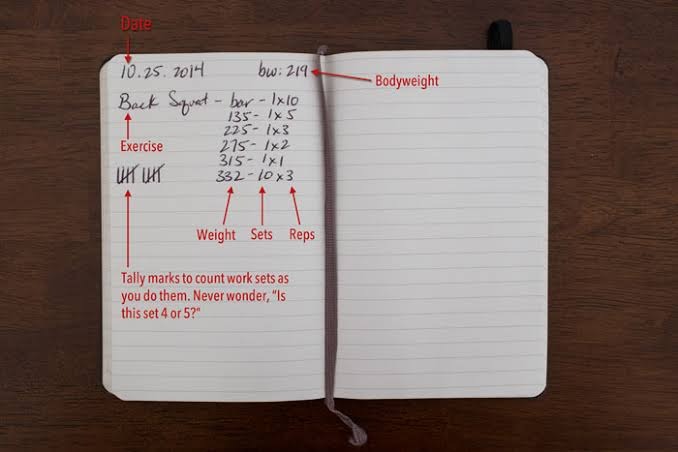
The only way to know if you have hit a true plateau—and actually need to change your program—is by meticulously tracking your lifts in a logbook.. Source: James Clear
Why Beginners Should Never “Write Their Own”
If you are a beginner, trying to figure out how long to follow a workout plan is usually preceded by trying to invent the plan yourself.
Writing a periodized strength program requires a deep understanding of volume management, fatigue accumulation, and exercise selection. When beginners try to write their own programs, they inevitably end up doing 15 sets of bicep curls and ignoring their hamstrings completely.
You need to follow a proven, structured program written by professionals. And more importantly, you need an environment that allows you to execute that program consistently for 12 weeks without bottlenecks.
The TFC Execution Environment
At Tulsa Fitness Club, we actively support structured lifting.
If you are running a 12-week program that calls for heavy deadlifts on Tuesdays, you cannot afford to train at a commercial gym where you have to wait 30 minutes for a platform.
We prioritize heavy-duty power racks, deadlift platforms, and classic “golden era” iron.
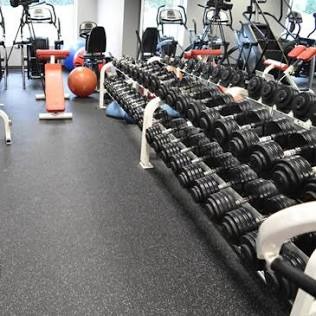
TFC provides the massive array of heavy hex dumbbells required to keep pushing progressive overload throughout a full 12-week mesocycle.. Source: Greatmats
We completely removed the guesswork and the hourly personal training meter by building elite programming directly into our memberships:
- Bronze Tier ($47/mo — Presale $37/mo): Unrestricted 24/7 access. You bring the structured 12-week program; we provide the iron.
- Silver Tier ($97/mo): Stop guessing. We provide you with expertly designed, periodized programming templates. We tell you exactly what movements to execute, and when it is mathematically time to switch the program.
- Gold Tier ($297/mo): The ultimate personal training replacement. Full 24/7 access, premium coaching check-ins, and highly customized programming. Our coaches track your metrics, assess your plateaus, and rotate your exercises when the biological data proves it is time.
Stop Program Hopping. Start Progressing.
If you jump from routine to routine every time you get bored, you will be the exact same size, lifting the exact same weight, five years from now.
Pick a proven, structured program. Execute it with violent consistency for at least 8 to 12 weeks. Track your numbers, respect your rest periods, and do it in an environment built for hard work.
Right now, you can lock in our Founding Member Presale Rate starting at just $37/month (with your first month for only $1).
And with the upcoming integration of our Catalyst Coworking space and Fuel Bar, TFC is rapidly becoming the ultimate off-site location for downtown professionals to execute their programming, grab a recovery shake, and transition immediately into deep-focus work.
Call us at 918-550-5549 or drop by 314 E 3rd St., Tulsa, OK 74120 during staffed hours to tour the facility, pick up your secure 24/7 key fob, and lock in your membership before the presale ends. No contracts. No fluff. Just structured strength.