What Is Progressive Overload? A Guide With Examples
Walk onto any commercial gym floor six months from today, and you will see the exact same people lifting the exact same weights they are lifting right now. They will sweat, they will burn calories, and they will leave feeling exhausted—but their physiques will remain entirely unchanged.
The fitness industry often sells the idea that simply showing up and moving your body is enough to build a strong, athletic physique. But human biology does not care how much you sweat. Your body is a highly efficient survival machine. If you subject it to a physical stressor (like lifting a 135-pound barbell), it will build just enough muscle tissue to survive that specific stressor. Once it adapts, the growth completely stops.
To force continuous muscle growth and strength adaptation, you must obey the absolute, non-negotiable law of the iron: progressive overload.
At Tulsa Fitness Club (TFC) in the historic Blue Dome District, our entire facility is engineered around this single principle. We didn’t fill our floor with trendy, fixed-path machines designed to make workouts “easier.” We built a 24/7 sanctuary stocked with the classic, heavy iron required to systematically force your body to adapt.
If you are tired of stalling your progress and want to know how to actually force your body to change, here is the definitive guide to understanding progressive overload, exactly how to execute it, and why your current gym might be making it impossible.
What Is Progressive Overload?
In physiological terms, progressive overload is the gradual increase of stress placed upon the musculoskeletal and nervous systems.
When you lift a weight that challenges you, you create micro-tears in your muscle fibers. During your recovery phase (while you sleep and process protein), your body repairs these fibers to be thicker and more resilient so that the same weight will not cause damage in the future.
If you go back to the gym and lift that exact same weight for the exact same number of repetitions, your body has no biological reason to build any more tissue. To force it to grow again, you must introduce a stimulus that is slightly harder than the one before. You must progressively overload the system.

The only way to guarantee you are applying progressive overload is to meticulously track your sets, reps, and weights in a logbook.. Source: Etsy
The 4 Methods of Progressive Overload (With Examples)
Most beginners assume that the only way to apply progressive overload is by adding more weight to the bar. While adding weight is the most straightforward method, it is not the only variable you can manipulate.
You can force adaptation by manipulating Load, Volume, Time Under Tension, or Rest.
1
1. Increase the Load (Weight)
The classic method
This is the most common form of progressive overload. You keep the sets and reps identical but increase the physical weight of the iron.
- Week 1: Barbell Squat: 3 sets of 8 reps at 200 lbs.
- Week 2: Barbell Squat: 3 sets of 8 reps at 205 lbs.
- Result: Your body must adapt to the 5-pound increase in mechanical tension.
2
2. Increase the Volume (Reps or Sets)
Pushing the endurance threshold
If you cannot safely add more weight to the bar, you can achieve overload by increasing the total volume of work performed with the same weight.
- Week 1: Flat Bench Press: 3 sets of 8 reps at 185 lbs.
- Week 2: Flat Bench Press: 3 sets of 9 reps at 185 lbs.
- Result: By squeezing out one extra repetition per set, you have increased the total volume (weight x sets x reps) your chest had to move.
3
3. Increase Time Under Tension (Tempo)
Mastering the eccentric phase
If you are stuck at a specific weight and cannot do more reps, you can slow down the movement. The eccentric (lowering) phase of a lift causes the most muscle damage.
- Week 1: Dumbbell Romanian Deadlift (RDL): 80 lbs, lowering the weight in 1 second.
- Week 2: Dumbbell RDL: 80 lbs, lowering the weight in 4 full seconds, pausing, and exploding up.
- Result: The muscle is placed under extreme tension for significantly longer, forcing hypertrophy without adding a single pound.
4
4. Decrease Rest Periods
Metabolic stress conditioning
Forcing your muscles to perform the exact same amount of work with less recovery time is a brutal and highly effective form of overload.
- Week 1: Overhead Press: 3 sets of 8 reps at 115 lbs (Resting 120 seconds between sets).
- Week 2: Overhead Press: 3 sets of 8 reps at 115 lbs (Resting 90 seconds between sets).
- Result: Your body is forced to clear lactic acid and replenish ATP (energy) faster, driving metabolic adaptation.
Was this visual helpful?
Yes No
The Commercial Gym Bottleneck: Why Your Environment Matters
Understanding progressive overload is only half the battle. Executing it consistently is where most people fail—and it is usually the fault of their gym environment.
If you are training at a crowded, sprawling commercial fitness center in the suburbs, the facility is actively fighting your progress. Here are three environmental bottlenecks that make progressive overload nearly impossible:
1. The Dumbbell Ceiling
If you use dumbbells for your heavy pressing or rowing movements, you will eventually hit the “dumbbell ceiling.” Most commercial gyms cap their dumbbells at 75 pounds because heavier weights require thicker rubber flooring and carry higher insurance liabilities. If you can bench press 75-pound dumbbells for 12 reps, you desperately need 80-pound dumbbells to apply progressive overload. If the gym doesn’t have them, your growth is permanently capped.
2. The Wait-Time Trap
Remember method #4 (Decreasing Rest Periods)? That variable requires strict control over your time. If your program dictates that you must rest exactly two minutes between sets of barbell squats, but you have to wait 20 minutes for one of the gym’s two power racks to open up, your rest period is destroyed. Your central nervous system cools down, and your progressive overload is entirely derailed.
3. Missing Micro-Plates
The human body does not adapt in massive, 10-pound increments. For smaller muscle groups (like the shoulders during an overhead press), adding a 5-pound plate to each side of the barbell (a 10-pound total jump) is a massive shock that usually results in failed reps. You need to micro-load the bar using 2.5-pound or even 1.25-pound fractional plates. Commercial gyms almost never stock these.
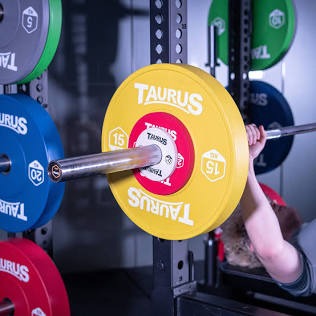
Micro-loading—adding just 2.5 pounds to the bar using fractional plates—is often the only way to sustain progressive overload on complex upper-body movements.. Source: Fitshop
The TFC Solution: Built for the Heavy Lifter
You shouldn’t have to rewrite your entire training program because your gym failed to purchase the right equipment.
At Tulsa Fitness Club, we actively stripped out the commercial fluff to build a gritty, focused sanctuary designed explicitly for executing progressive overload.

TFC provides the heavy-duty power racks and elite iron necessary to execute progressive overload consistently without waiting in line.. Source: The Manual
Here is how we support your progress:
- The Right Ratios: We prioritize heavy-duty power racks, deadlift platforms, and competition-grade iron so you never have to wait to execute your primary compound lifts.
- No Ceilings: Our heavy hex dumbbells go far beyond the standard commercial limit. We also stock specialty barbells and fractional plates, giving you the exact tools you need to micro-load and smash through plateaus.
- Unrestricted 24/7 Access: Your encrypted digital key fob grants you entry 365 days a year. If you need to hit a new personal record in absolute silence at 4:30 AM, the gym is entirely yours.
Elite Coaching: Stop Guessing Your Numbers
If tracking your volume and managing your progressive overload feels like a math equation you don’t want to solve, we have built elite programming directly into our transparent membership tiers.
- Bronze Tier ($47/mo — Presale $37/mo): Unrestricted 24/7 access. You bring your logbook; we provide the iron.
- Silver Tier ($97/mo): 24/7 access plus expertly designed programming templates. We tell you exactly what weights to hit and when to increase the load, removing the guesswork entirely.
- Gold Tier ($297/mo): The ultimate accountability package. Full access, premium coaching check-ins, and highly customized programming. A professional strength coach tracks your progressive overload, reviews your form via video, and adjusts your variables to ensure you never stall.
The Presale Advantage: Right now, you can lock in our Founding Member Presale Rate starting at just $37/month(with your first month for only $1).
Furthermore, with the upcoming integration of our Catalyst Coworking space and Fuel Bar, TFC is rapidly becoming the ultimate off-site location for downtown professionals. You can execute your meticulously planned lifting session, grab a recovery shake, and transition immediately into deep-focus work in our secure Wi-Fi lounge.
Stop doing the exact same workout you were doing six months ago. Force your body to adapt.
Call us at 918-550-5549 or drop by 314 E 3rd St., Tulsa, OK 74120 during staffed hours to tour the facility, pick up your secure key fob, and lock in your Founding Member pricing before the presale ends. No contracts. No hidden fees. Just pure, progressive strength.