Old School Gym in Tulsa: What It Looks Like and Who It Fits
If you walked into a gym in the late 1970s or 1980s—the golden and silver eras of bodybuilding—you were immediately hit by a highly specific atmosphere. The air smelled of chalk and sweat. The sound of heavy iron plates clashing against steel bars echoed off the walls. There were no juice bars, no massage chairs, and certainly no rows of televisions distracting you from the task at hand. You went there for one singular purpose: to lift heavy weight and force your body to adapt.
Over the last three decades, the commercial fitness industry systematically dismantled that environment.
In the pursuit of selling thousands of unused memberships, corporate mega-gyms sanitized the training experience. They replaced the heavy iron with cheap, fixed-path machines to limit liability. They banned chalk because it was messy. They installed “lunk alarms” to actively punish anyone who exerted genuine physical effort. They transformed the gym from a crucible of physical adaptation into a sterile, climate-controlled entertainment center.
But a massive demographic of driven professionals and serious athletes has finally had enough of the corporate fluff.
The demand for a true old school gym in Tulsa is higher than it has ever been. People are realizing that you cannot build absolute strength, dense muscle tissue, and mental resilience by casually pedaling a stationary bike while watching a screen.
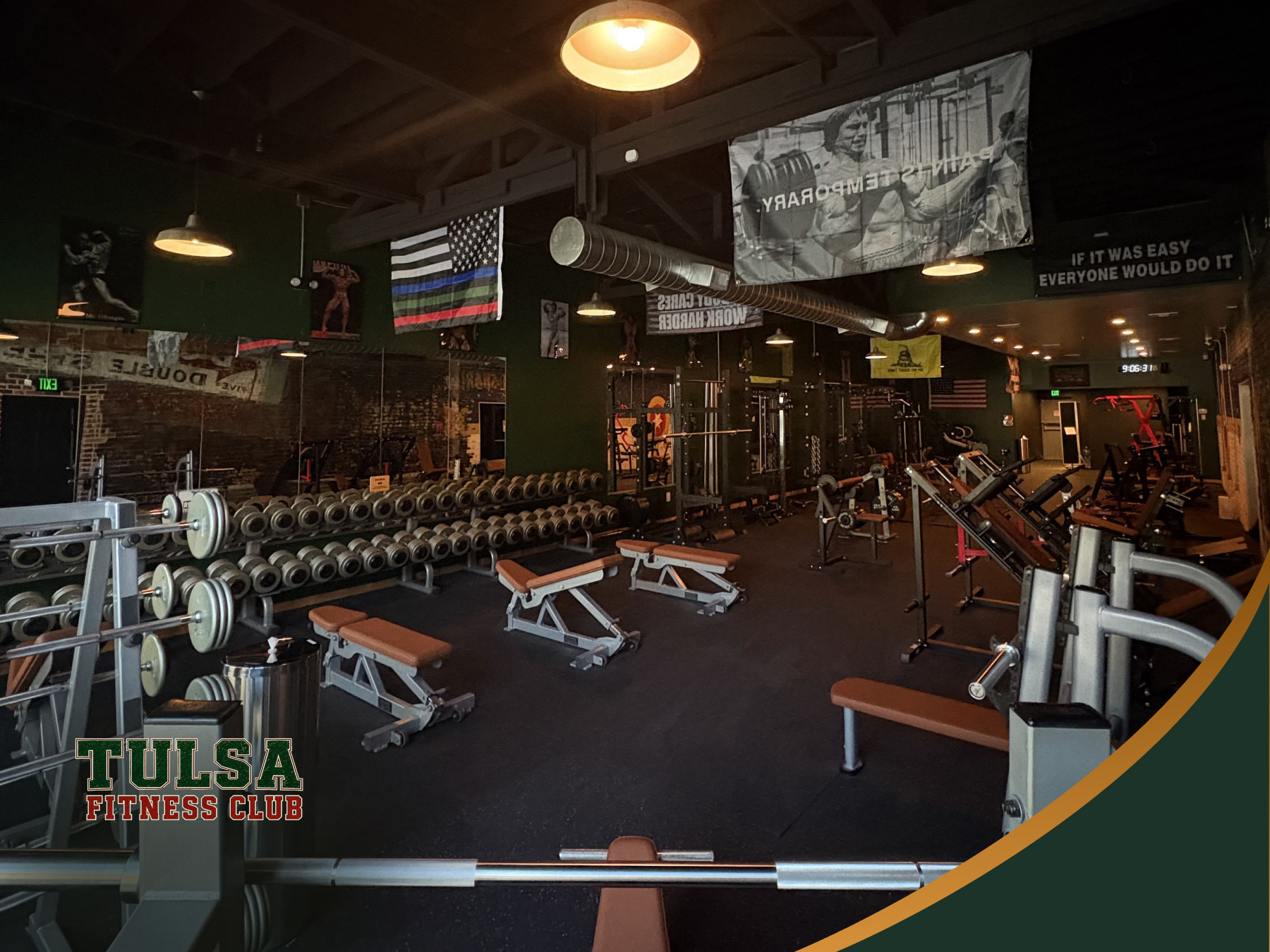
At Tulsa Fitness Club (TFC), located at 314 E 3rd St. in the historic Blue Dome District, we actively resurrected the golden-era training environment, but we stripped out the toxic meathead stereotypes. We built a facility that merges the gritty, heavy-duty infrastructure of an old-school barbell club with the autonomy and integration required by modern downtown professionals.
If you are tired of the commercial fitness machine and are wondering what an old-school strength sanctuary actually looks like today, here is the brutally honest breakdown of the environment, the equipment, and the culture.
Part 1: The Anatomy of an Old School Gym
You can identify a true old-school gym within five seconds of walking through the front door. It is an entirely different sensory experience than a corporate health club.
A corporate gym feels like a hospital waiting room. An old-school gym feels like a workshop.
The Visual Aesthetic
We did not build TFC to look like a futuristic spaceship. We embraced the raw, industrial architecture of downtown Tulsa.When you step onto our floor, you will see exposed brick walls, natural light pouring in from massive windows, and rugged steel structures. There is no neon mood lighting, and there are no mirrored selfie rooms.
The aesthetic serves a psychological purpose. When the environment is raw and unpolished, it signals to your brain that this is a place for labor, not leisure. It strips away the pretense and forces you to confront the iron in front of you.
An authentic old-school environment relies on raw, industrial aesthetics like exposed brick and natural light to foster a culture of hard work.. Source: Vecteezy
The Auditory Experience
Silence is the enemy of exertion. In a commercial mega-gym, the management demands absolute silence from the lifters. If you grunt during a maximal-effort squat or if your deadlift makes a loud noise when it hits the floor, a manager will hand you a warning.
In a genuine old-school gym, physical noise is the soundtrack of progress. Heavy compound lifting requires aggressive core bracing, which inherently produces noise. When you are pulling a 400-pound barbell from the floor, it is going to make a massive sound when the plates strike the wooden platform. At TFC, we do not have alarms to shame our members; we encourage the noise of execution.
The Tactile Reality (The Chalk Rule)
Perhaps the greatest dividing line between a corporate fitness center and a true old-school gym is the chalk policy.
Corporate gyms ban lifting chalk because it gets on the floor and requires them to vacuum more often. This is a catastrophic biological oversight. When you are lifting heavy weight—especially during pulling movements like deadlifts, heavy rows, and pull-ups—your grip will naturally slip as your hands sweat. Chalk dries the skin and creates absolute friction between your hand and the knurling of the barbell.
Banning chalk means the gym cares more about their janitorial budget than your physical safety. In an old-school facility, chalk is not just allowed; it is a mandatory tool for pushing past your natural grip limitations.
Chalk is a mandatory tool for serious strength training. It provides the friction necessary to grip heavy iron safely and securely.. Source: PeopleImages
Part 2: Iron Over Algorithms (The Equipment)
The core philosophy of an old-school gym is that human biology has not changed in 10,000 years. Your central nervous system and your muscular system respond to one thing: heavy mechanical tension.
You do not need an app-connected, digital resistance machine with a touchscreen to build a powerful physique. You need gravity, and you need iron.
When you evaluate a gym’s authenticity, you must evaluate how they allocate their floor space. Corporate gyms dedicate 80% of their square footage to cardio machines and fixed-path isolation circuits. A true old-school gym flips that ratio entirely, dedicating the massive majority of its space to free weights.
1. The Power Rack Dominance
The barbell back squat and the barbell overhead press are the foundational pillars of absolute strength. To execute them safely, you need a heavy-duty power rack equipped with adjustable safety pins.
At a corporate gym, you might find two power racks for 5,000 members. At TFC, we over-indexed on commercial-grade power racks. We know that our members are there to do serious work, which means we must provide the infrastructure to eliminate bottlenecks. You should never have to wait 25 minutes to execute your primary lifting block.
2. Dedicated Deadlift Platforms
You cannot pull heavy weight on thin, rubberized corporate gym flooring without destroying the concrete foundation underneath. An old-school gym provides thick, dedicated wooden deadlift platforms paired with competition-grade bumper plates. This specific infrastructure allows athletes to pull maximal loads and drop the barbell aggressively without fear of damaging the facility or disturbing other members.
3. Heavy Dumbbells That Don’t Stop at 50 Pounds
One of the most frustrating aspects of an apartment fitness center or a budget corporate gym is the dumbbell rack. They almost always cap their dumbbells at 50 or 75 pounds.
If you are a moderately trained male or female athlete, you will physically outgrow a 75-pound dumbbell for exercises like heavy flat benches, incline presses, or single-arm rows in a matter of months. An old-school facility understands the necessity of progressive overload. Our heavy hex dumbbells scale far beyond the commercial limits, ensuring that no matter how strong you become, the facility will never become the bottleneck to your progression.
Progressive overload requires uncapped resistance. An authentic strength facility provides heavy dumbbells that scale with your physical progression.. Source: RitFit
Part 3: The Culture: Who Actually Fits Here?
There is a massive misconception that old-school gyms are only for elite powerlifters, competitive bodybuilders, and aggressive “meatheads.”
While those athletes absolutely thrive in this environment, the true culture of a modern old-school gym is far more diverse. It is not defined by how much weight you can lift; it is defined entirely by your mindset.
If you are looking for an old school gym in Tulsa, you will find that TFC is the perfect fit for three specific demographics:
1. The Driven Downtown Professional Corporate executives, lawyers, entrepreneurs, and medical professionals spend their entire day dealing with complex, high-stress variables. When they go to the gym, they want a raw, unfiltered environment where the rules are simple: lift the weight, or don’t. They do not want to be sold personal training packages, and they do not want to navigate a chaotic social club. They want to put their headphones on, execute a brutal 45-minute heavy lifting block, and leave. The old-school environment respects their time and their intensity.
2. The Serious, Autoregulated Lifter If you run a highly specific strength program—like a 5/3/1 protocol, a Westside Barbell conjugate method, or a periodized hypertrophy block—you cannot train at a commercial gym. You need specialty barbells (like Trap Bars and Safety Squat Bars), you need chalk, and you need to monopolize a power rack for 30 minutes without a staff member asking you to move. The old-school gym is built specifically to accommodate the logistics of advanced programming.
3. The Focused Beginner This is the most surprising demographic. Many beginners are terrified of old-school gyms because they assume they will be judged for lifting light weight. The reality is the exact opposite. In a commercial gym, people are often there to socialize, look at each other, and film themselves for social media. In an old-school gym, everyone is fighting their own physical battles. A 250-pound powerlifter respects a 120-pound beginner who is fighting through a hard set of goblet squats, because they recognize the effort. The culture is built on mutual respect for the labor, regardless of the load.
Part 4: The Tulsa Fitness Club Evolution
While we deeply respect the gritty, raw aesthetics and heavy iron of the golden era, we also recognize that the modern professional requires modern integration.
We did not just recreate a 1980s basement gym; we evolved the model to fit the lifestyle of the Tulsa Arts District and Blue Dome District local. We took the heavy iron of the old school and paired it with the professional amenities of the future.
24/7 Unrestricted Autonomy
In the golden era, you had to train when the gym owner felt like unlocking the doors. At TFC, your schedule never dictates your strength. Every member receives an encrypted digital key fob granting unrestricted 24/7 access to the facility, 365 days a year. If you want to blast heavy metal and pull deadlifts at 2:30 AM, you have absolute autonomy over your training environment.
The Professional Ecosystem: Catalyst Coworking
This is where TFC completely separates itself from every other gym in Oklahoma. We are actively developing the Catalyst Coworking space and an on-site TFC Fuel Bar.
Downtown Tulsa Partnership
We know that commuting between an old-school gym, your apartment, and a coffee shop burns massive amounts of your daily time. We consolidated the routine. You can walk into TFC, execute a raw, heavy barbell workout in an old-school environment, and hit the private showers.
We merged old-school grit with modern efficiency. After a heavy lifting session, you can transition immediately into Catalyst Coworking for deep-focus professional work.. Source: Business Insider
You can then grab a high-protein recovery shake from the Fuel Bar and transition immediately into our secure Wi-Fi coworking lounge. You can knock out a morning of deep-focus work, answer emails, and hold remote meetings without ever leaving the building. It is the ultimate integration of physical progression and professional output.
Part 5: Lock In Your Membership (Without the Contract Trap)
The final piece of the old-school ethos is business transparency. Corporate gyms survive by locking you into predatory 12-month contracts with hidden annual fees. If you try to leave, they threaten your credit.
At Tulsa Fitness Club, we operate on a strict, transparent, no-contract basis. We retain our members by providing elite equipment, not by holding their bank accounts hostage.
If you are ready to abandon the commercial cardio rooms and graduate to a facility that respects the iron, we offer three distinct tiers:
- The Bronze Tier: The Independent Iron ($47/month) Unrestricted 24/7 access to the heavy iron, the platforms, and the facility. Perfect for the independent lifter who just needs a serious space to execute.
- The Silver Tier: The Blueprint ($97/month) 24/7 access plus expertly designed, periodized programming templates. We outline exactly how to sequence your compound lifts and when to apply progressive overload.
- The Gold Tier: The Executive Partnership ($297/month) The ultimate coaching replacement. Full access, highly customized programming, and premium coaching check-ins. Your TFC coach tracks your progress and reviews your lifting videos to ensure your mechanics are flawless.
The Presale Advantage: Right now, you can lock in our Founding Member Presale Rate starting at just $37/monthfor the Bronze Tier (with your first month for only $1).
Tulsa Fitness Club
Stop subsidizing the amenities you never use at corporate mega-gyms. Demand access to real iron, secure your absolute pricing transparency, and train in a gritty, downtown facility that demands your best effort.
Call us at 918-550-5549 or drop by our location at 314 E 3rd St., Tulsa, OK 74120 during our staffed hours to tour the facility, pick up your secure 24/7 key fob, and lock in your Founding Member pricing before the presale ends.