How Many Days a Week Should You Lift? A Plan for Each Experience Level

If you scroll through modern fitness culture, you will immediately notice a massive, contradictory divide in advice.
On one side, you have corporate mega-gyms telling you to come in seven days a week to casually walk on a treadmill for twenty minutes and stretch. On the other side, you have social media influencers claiming you need to execute brutal, two-hour “beast mode” lifting sessions every single day if you want to see an ounce of progress.
Both approaches are biologically incorrect, and both will ultimately lead to frustration, burnout, or catastrophic injury.
When you strip away the corporate marketing and the social media posturing, you are left with a purely scientific question: How many days a week should you lift?
The answer is not a random number picked out of thin air. It is entirely dependent on your training age, your central nervous system (CNS) capacity, and your ability to recover. At Tulsa Fitness Club (TFC), located at 314 E 3rd St. in the historic Blue Dome District, we do not deal in fitness industry myths. We deal in the physics of heavy iron and the biology of human adaptation.
If you are tired of spinning your wheels and want to engineer a routine that actually forces your body to grow, here is the brutally honest, scientifically backed blueprint for exactly how often you should be under the bar.
1. The Biology of Adaptation: Why More Isn’t Always Better
Before you can choose a training schedule, you must fundamentally understand how muscle is built.
When you execute a heavy barbell squat or a dumbbell bench press, you are not building muscle. You are actually doing the exact opposite. You are tearing muscle fibers, creating micro-traumas in the tissue, and massively fatiguing your central nervous system.
The actual growth—the physical adaptation that makes you stronger and more muscular—happens after you leave the gym. It happens when you are eating, and more importantly, when you are sleeping.
The Muscle Protein Synthesis Window
When you stimulate a muscle through heavy mechanical tension, your body elevates a biological process called muscle protein synthesis (MPS). For a natural athlete, this window of elevated MPS typically lasts between 36 and 72 hours, depending on the severity of the stimulus.
If you train your chest on Monday, your pectoral muscles are actively rebuilding until Wednesday or Thursday.
The Danger of Junk Volume
If you decide to train your chest again on Tuesday while it is still in the middle of the recovery phase, you are interrupting the rebuilding process. You are inflicting new damage on tissue that has not yet healed. This is known as “junk volume.” Over time, this leads to chronic overtraining, nagging joint pain, and a complete plateau in your strength numbers.
A corporate cardio center wants you to visit every day because their machines don’t cause enough tissue damage to require systemic recovery. But in a hardcore barbell club, the iron demands respect. The heavier you lift, the more time your biology requires to recover.

Heavy compound lifting causes systemic fatigue. You cannot train like this every single day without suffering from central nervous system burnout.. Source: YouFit Gyms
2. The Beginner Blueprint: 3 Days a Week
If you are within your first 12 months of serious strength training, you are in the “novice” phase. This is the most lucrative phase of your lifting career, often referred to as “newbie gains.” Your body is hyper-responsive to mechanical tension because it has never experienced it before.
If you are a beginner wondering how many days a week should you lift, the answer is definitively three days a week.
The Protocol: Full Body Splits
As a beginner, you do not need to isolate individual muscles. Doing five different variations of bicep curls is a complete waste of your time. You need to focus entirely on the primary compound movements that trigger massive, systemic hormonal responses.
A 3-day full-body split (typically Monday, Wednesday, Friday) is the gold standard.
- Day 1 (Monday): Squat, Bench Press, Barbell Rows.
- Day 2 (Wednesday): Deadlift, Overhead Press, Pull-ups.
- Day 3 (Friday): Squat (Lighter variation), Incline Press, Heavy Dumbbell Rows.
Why It Works
By training three days a week, you are hitting every major muscle group three times a week. Because you are a beginner, the absolute weight on the bar is not yet heavy enough to completely fry your central nervous system. You can recover from a heavy squat session in 48 hours. This frequency allows you to practice the mechanical execution of the lifts frequently while ensuring you have a full day of recovery between every single session.
3. The Intermediate Grind: 4 Days a Week
After 12 to 18 months of consistent training, a biological shift occurs. You will eventually become too strong for a 3-day full-body split.
When your barbell squat jumps from 135 pounds to 315 pounds, the systemic fatigue generated by that lift is massive. You can no longer squat heavy on Monday and expect your lower back and CNS to be fully recovered by Wednesday to pull heavy deadlifts. You need to spread the volume out.
For the intermediate lifter, the answer to how many days a week should you lift shifts to four days a week.
The Protocol: Upper / Lower Split
To manage the fatigue of heavier weights, intermediate athletes must divide the body in half. The Upper/Lower split allows you to hit every muscle group twice a week (which is optimal for muscle hypertrophy) while giving your joints and nervous system adequate time to rest.
- Monday: Upper Body Strength (Heavy Bench, Heavy Rows)
- Tuesday: Lower Body Strength (Heavy Squats, Hamstring isolation)
- Wednesday: Complete Rest
- Thursday: Upper Body Hypertrophy (Incline Dumbbells, Lat Pulldowns, Arms)
- Friday: Lower Body Hypertrophy (Deadlifts, Leg Press, Calves)
- Saturday & Sunday: Complete Rest
Why It Works
This 4-day split is arguably the most effective, sustainable schedule for the driven professional. It allows for intense, focused 60-to-90-minute sessions while keeping the weekends entirely free for recovery and life obligations.
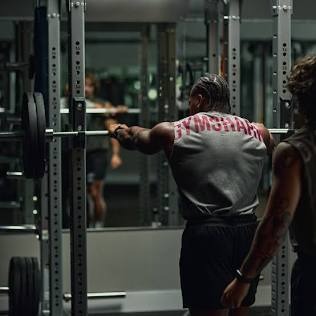
As you transition to the intermediate phase, the loads become significantly heavier. An Upper/Lower 4-day split provides the necessary CNS recovery time between massive compound lifts.. Source: Gymshark
4. The Advanced Protocol: 5 to 6 Days a Week
When you have been training consistently for three to five years, your body is heavily armored with dense muscle tissue, and your central nervous system is highly conditioned to stress. To force further adaptation at this elite level, you require immense amounts of training volume.
For the advanced bodybuilder or the competitive athlete, you must train five to six days a week.
The Protocol: Push / Pull / Legs (PPL)
You can no longer fit all your upper body volume into a single session without spending three hours in the gym. The PPL split breaks the body down into its primary biomechanical functions.
- Day 1: Push (Chest, Shoulders, Triceps)
- Day 2: Pull (Back, Biceps, Rear Delts)
- Day 3: Legs (Quads, Hamstrings, Calves)
- Day 4: Rest (or repeat the cycle immediately for a 6-day rolling split)
The Biological Warning
Training six days a week is a logistical and biological tightrope. If your nutrition is not perfectly dialed in, if you are not sleeping seven to eight hours a night, and if you are highly stressed at work, a 6-day split will destroy your immune system and lead to injury.
Furthermore, you cannot execute a 6-day rolling split in a corporate gym that restricts its weekend hours. If your heavy Leg day falls on a Sunday and the commercial franchise locks its doors at 5:00 PM, your entire mesocycle is ruined.

Advanced athletes require massive volume to trigger hypertrophy. A 5-to-6-day Push/Pull/Legs split isolates biomechanical functions to maximize tissue damage and recovery.. Source: Advanced Human Performance
5. The Schedule Dictates the Gym (The TFC Ecosystem)
Whether you are a beginner running a 3-day split or an advanced lifter executing a brutal 6-day PPL protocol, your central nervous system does not operate on a corporate 9-to-5 schedule.
If you are a driven professional, your availability to train might be at 4:30 AM before a board meeting or at 11:30 PM after a chaotic medical shift. If you have to fight your gym’s administrative hours to get your workouts in, your consistency will inevitably fail.
We engineered Tulsa Fitness Club to remove the logistical friction from your training split.
Unrestricted 24/7 Autonomy
Every TFC member is issued an encrypted digital key fob granting unrestricted 24/7 access to the facility, 365 days a year. We do not rope off the heavy iron at night, and we do not close early on Sundays. You possess total autonomy over your training environment. Your schedule dictates your strength.
Engineered for Force Production
Regardless of how many days a week you lift, you cannot build absolute strength on budget equipment. We stripped out the corporate cardio fluff and over-indexed on the heavy iron.
- Commercial Power Racks: Multiple 11-gauge steel power racks equipped with robust safety pins. You never have to wait 30 minutes in line to execute a heavy barbell squat.
- Dedicated Deadlift Platforms: Thick wooden deadlift platforms and competition-grade plates allow you to pull maximal weight from the floor with absolute aggression.
- Uncapped Resistance: Our heavy hex dumbbells scale far beyond the 50-pound commercial limit.
6. Integrating the Professional Routine (Catalyst Coworking)
If you are committing to a 4-day or 5-day training split, commuting endlessly between your downtown apartment, a gritty barbell club, and a local coffee shop burns massive amounts of your limited daily time.
We consolidated the routine by integrating our Catalyst Coworking space and the on-site TFC Fuel Bar directly into the facility.

TFC integrates your physical training with your professional output. Knock out your heavy lifting block and transition immediately into our Catalyst Coworking space.. Source: Business Insider
You can walk into TFC, execute a brutal 60-minute lifting block, hit the private showers, and grab a high-protein recovery shake from the Fuel Bar. You can then transition immediately into our secure Wi-Fi coworking lounge. You can knock out a morning of deep-focus professional work in a highly energized environment without ever leaving the building.
7. Built-In Coaching: Stop Guessing Your Routine
If you are still confused about how many days a week you should lift, or if you don’t know how to properly periodize an Upper/Lower split, you do not have to guess.
At corporate gyms, if you ask for help, they will ambush you with a high-pressure sales pitch for an $80-an-hour personal trainer. At TFC, we baked elite coaching directly into our transparent pricing tiers:
The Bronze Tier: The Independent Iron ($47/month) Unrestricted 24/7 access to the heavy iron, the massive dumbbell racks, and the dedicated platforms. Perfect for the independent lifter who already has their 4-day or 5-day programming dialed in and simply needs the hardware.
The Silver Tier: The Blueprint ($97/month) If you are tired of spinning your wheels, the Silver Tier provides 24/7 access plus expertly designed, periodized programming templates. We outline exactly how to structure your 3-day, 4-day, or 5-day splits to ensure progressive overload without frying your central nervous system.
The Gold Tier: The Executive Partnership ($297/month) The ultimate coaching replacement for the driven athlete. You receive full Silver access, plus highly customized programming tailored to your specific biomechanics, injury history, and schedule. Your TFC coach tracks your metrics and reviews your lifting videos to ensure your free-weight mechanics are absolutely flawless.
8. The Ultimate Test: The Presale Advantage
We believe the absolute best way to truly experience a gym is to run your training split consistently for a few weeks without the threat of a predatory contract hanging over your head.
Right now, you can lock in our Founding Member Presale Rate starting at just $37/month for the Bronze Tier (with your first month for only $1).
You pay your dollar, you sign a waiver, and you get immediate, 24/7 access to the heavy iron. Because we require zero 12-month contracts and charge zero hidden maintenance fees, you are completely free to cancel if the gritty, old-school environment isn’t the right fit for you.
Stop letting corporate administrative hours and confusing fitness myths dictate your physical potential. Demand access to real, heavy iron, secure your absolute pricing transparency, and train in a gritty, downtown facility that respects the intense work you put in.
Call us at 918-550-5549 or drop by our location at 314 E 3rd St., Tulsa, OK 74120 during our staffed hours to tour the facility, pick up your secure 24/7 key fob, and lock in your Founding Member pricing before the presale ends. The only question left is which days you are going to show up.