Gym With Heavy Dumbbells: Why the Top of the Rack Matters
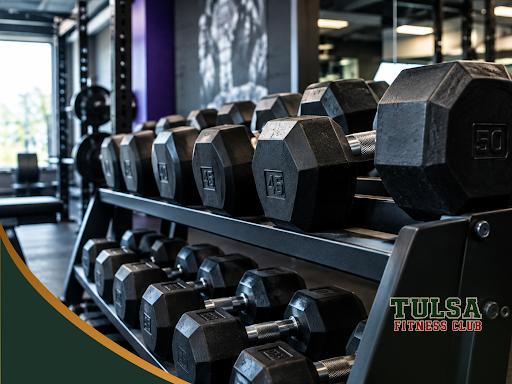
It usually happens about six months into your training journey. You walk into your apartment fitness center or your corporate mega-gym, grab the heaviest dumbbells on the rack, and lie back on the bench. You press the weight. It flies up with zero resistance. You execute 15, then 20 reps. You sit up, look at the end of the rack, and realize a brutal truth: you have physically outgrown your gym.
For the casual gym-goer, a rack that stops at 50 or 75 pounds is perfectly adequate. But for a driven athlete, a bodybuilder, or a professional aggressively pursuing progressive overload, the top end of the dumbbell rack is the ultimate litmus test of a facility’s culture.
If you are searching for a gym with heavy dumbbells, you are not just looking for more iron. You are looking for a facility that expects you to grow.
At Tulsa Fitness Club (TFC), located at 314 E 3rd St. in the historic Blue Dome District, we believe your gym should never be the bottleneck to your physical potential. We engineered a facility that scales with your absolute strength. If you are tired of maxing out the rack at your current commercial gym, here is the brutally honest, biomechanical breakdown of why heavy dumbbells are non-negotiable for serious athletes, and why the corporate fitness machine refuses to supply them.
1. The Economics of the 50-Pound Limit
To understand why it is so difficult to find a gym with heavy dumbbells, you have to understand the underlying economics of the commercial fitness industry. Corporate health clubs do not make their money by transforming their members into elite, muscular athletes. They make their money by selling thousands of memberships to people who never show up.
Because their target demographic is the absolute beginner or the casual cardio enthusiast, their equipment purchasing decisions are dictated entirely by two factors: liability and cost.
The Liability Factor
When a commercial gym manager looks at a 120-pound dumbbell, they do not see a tool for building a massive chest and dense shoulder stabilizers. They see a massive insurance liability. Heavy dumbbells require serious physical exertion, aggressive core bracing, and the occasional dropping of weight when a lifter reaches muscular failure.
Corporate gyms hate exertion. They hate the noise of heavy iron hitting the floor. To mitigate this “risk,” they simply remove the heavy iron from the equation. They force you onto fixed-path, padded isolation machines where the risk of dropping a weight is zero, but the functional strength adaptation is equally close to zero.
The Cost of Dense Iron
Cast iron and machined steel are incredibly expensive. A commercial rack of dumbbells that scales from 5 pounds up to 50 pounds is relatively cheap to purchase and ship. But as the dumbbells scale past 100, 120, and 150 pounds, the cost of the raw materials and the heavy-duty reinforced racks required to hold them skyrockets.
Corporate mega-gyms would rather spend that capital on a row of twenty new elliptical machines with built-in televisions than invest in the heavy iron required by the top 5% of their strongest members.
“When a gym caps their dumbbell rack at 75 pounds, they are sending a very clear psychological signal to their members: We do not expect you to get strong, and if you do, we do not want you here.”

A heavy dumbbell is a precision instrument for progressive overload. If your gym caps the rack at 50 pounds, they have artificially capped your central nervous system’s ability to adapt.. Source: Vecteezy
2. Biomechanics: The Necessity of Unilateral Load
A common counter-argument from commercial gym apologists is, “If the dumbbells are too light, just use the barbell.”
While the barbell back squat, deadlift, and bench press are the undisputed kings of absolute force production, relying exclusively on bilateral barbell movements is a biomechanical trap. You must incorporate heavy unilateral (single-arm or single-leg) training into your programming to build a resilient, injury-resistant physique.
Here is exactly why heavy dumbbells are a biological necessity:
Fixing Neuromuscular Asymmetries
When you press a heavy barbell, your central nervous system is highly efficient at masking your weaknesses. If your right triceps and anterior deltoid are 15% stronger than your left, your body will subconsciously shift the load to the right side of the barbell to complete the repetition. Over time, this creates massive muscular imbalances that eventually lead to catastrophic joint injuries.
Dumbbells force absolute accountability. If you are pressing a pair of 100-pound dumbbells, your left side must independently stabilize and press 100 pounds. It cannot borrow force from the right side. Heavy dumbbells actively hunt down and destroy neuromuscular weak points.
Enhanced Range of Motion and Deep Fascial Stretch
A barbell physically stops when the steel hits your chest. While this is great for moving maximal weight, it arbitrarily limits your anatomical range of motion.
When you execute a flat dumbbell bench press or a heavy dumbbell row, the independent nature of the weights allows you to lower the load significantly past the midline of your body.
- Metabolic Stress: This deep, extended range of motion places the target muscle under extreme stretch while fully loaded.
- Hypertrophy Signaling: Stretching a loaded muscle physically pulls on the fascia (the tough connective tissue surrounding the muscle belly) and triggers a massive hypertrophic (muscle growth) response that a barbell cannot replicate.
- Joint Health: Training a joint through its absolute full range of motion strengthens the tendons and ligaments at their most vulnerable points, heavily bulletproofing the joint against future tears.
The heavy single-arm dumbbell row requires massive weight to trigger back growth. You cannot build a thick, dense latissimus dorsi with a 50-pound weight.. Source: Breaking Muscle
3. The “Big Three” Movements That Demand Heavy Dumbbells
If you are a serious athlete running a periodized hypertrophy or strength block, there are specific movements in your programming that will instantly expose a poorly equipped commercial gym. These movements require massive loads to be effective.
A. The Single-Arm Dumbbell Row
The latissimus dorsi and the rhomboids are massive, incredibly powerful muscle groups designed to pull heavy loads. If you are a 180-pound male who has been training for more than a year, a 75-pound dumbbell will not provide enough mechanical tension to trigger back growth.
- The Execution: To build genuine back thickness, you need to brace your non-working hand on a bench, plant your feet aggressively, and pull a 100, 120, or even 150-pound dumbbell from a dead hang to your hip.
- The Commercial Gym Failure: When a gym lacks heavy dumbbells, lifters are forced to do endless, high-rep sets of rows that only generate a light pump, or they abandon the movement entirely for the seated cable row machine, losing the core stabilization benefits.
B. The Flat and Incline Dumbbell Chest Press
While the barbell bench press builds absolute pressing power, the heavy dumbbell press is arguably superior for pure chest hypertrophy. It allows you to actively squeeze your hands inward at the top of the movement, fully contracting the pectoral fibers.
- The Execution: A trained lifter needs the ability to press 100+ pound dumbbells in each hand to continue forcing adaptation in the chest and anterior deltoids.
- The Commercial Gym Failure: Lifters at commercial gyms hit the 75-pound limit and are forced to transition to the Smith machine or padded chest press machines, completely removing their rotator cuff stabilizers from the equation.
C. The Bulgarian Split Squat
The Bulgarian Split Squat (rear-foot elevated split squat) is one of the most brutal and effective leg-builders in existence. It heavily targets the quads and glutes while completely removing loading stress from the lower spine.
- The Execution: Because the legs are so powerful, a trained athlete quickly graduates to holding massive weight during this movement. Holding a pair of 80 or 100-pound dumbbells during a Bulgarian split squat requires absolute full-body tension, crushing grip strength, and elite balance.
- The Commercial Gym Failure: Without heavy dumbbells, athletes are forced to do 30+ reps per leg with light weight, turning a primary strength movement into a miserable cardio endurance test.
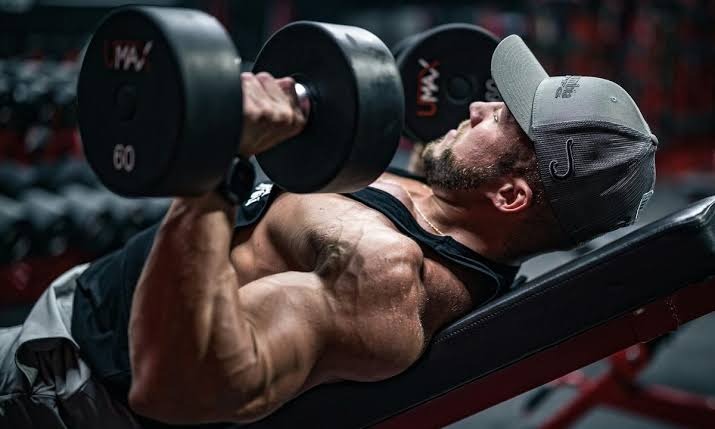
The heavy dumbbell chest press is unmatched for pectoral hypertrophy. It forces independent stabilization and allows for a much deeper stretch than a standard barbell.. Source: The Manual
4. The Tulsa Fitness Club Arsenal: Iron Without Limits
When we designed Tulsa Fitness Club, we looked at the massive gaps left by the commercial fitness industry in downtown Tulsa. We knew that driven professionals, competitive powerlifters, and classic bodybuilders did not want another resort club. They wanted a sanctuary where the equipment matched their ambition.
We over-indexed on the heavy iron.
- The Endless Dumbbell Rack: We do not stop at 50, 75, or even 100 pounds. We stock commercial-grade, heavy hex dumbbells that scale into the extreme upper limits of human strength. When you walk onto our floor, the length and weight of the dumbbell rack sends an immediate psychological signal: You are expected to put in the work, and the facility will support you no matter how strong you get.
- The Supporting Infrastructure: Heavy dumbbells are useless if you don’t have the benches to support them. Commercial gym benches are often narrow, slick, and flimsy, causing your shoulder blades to slide off when you press heavy weight. TFC provides competition-grade, wide-pad benches with grippy upholstery, ensuring you have a massive, stable foundation to press from.
- Multiple Power Racks and Deadlift Platforms: We pair our heavy dumbbell racks with multiple heavy-duty, 11-gauge steel power racks and dedicated wooden deadlift platforms. You never have to compromise a lifting block or wait 30 minutes in line to execute your programming.
5. The Professional Downtown Ecosystem
Having the right hardware is only half the battle. The other half is ensuring that your gym integrates seamlessly into your daily lifestyle.
If you have to fight 30 minutes of suburban highway traffic just to find a gym with heavy dumbbells, your consistency will inevitably fail. We placed TFC squarely in the Blue Dome District to serve the downtown professional, the medical worker, and the Arts District resident.
Unrestricted 24/7 Autonomy
Your central nervous system does not operate on a corporate 9-to-5 schedule. If you want to execute a heavy, high-volume dumbbell chest press session at 4:30 AM before a massive board meeting, or at 11:30 PM after a chaotic shift, you need absolute access.
Every TFC member is issued an encrypted digital key fob granting unrestricted 24/7 access to the facility, 365 days a year. We do not restrict our hours on holidays, and we do not close the heavy free-weight section at night. You possess total autonomy over your training environment.
Catalyst Coworking and The Fuel Bar
We didn’t just build a better dumbbell rack; we built a comprehensive daily hub.
We are actively developing our Catalyst Coworking space and the on-site TFC Fuel Bar. Instead of commuting endlessly between a gym, your loft, and a coffee shop, you can consolidate your routine.
Imagine executing a brutal 45-minute heavy lifting block, hitting the private showers, and grabbing a high-protein recovery shake from the Fuel Bar. You can then transition immediately into our secure Wi-Fi coworking lounge. You can knock out a morning of deep-focus professional work in a highly energized environment without ever leaving the building.
We merged the absolute physical intensity of an old-school barbell club with the professional efficiency of a modern downtown workspace.
6. Built-In Coaching (Stop Guessing Your Routine)
If you are ready to graduate from your apartment gym but aren’t sure how to properly transition from light machines to heavy, unilateral dumbbell movements, we baked elite coaching directly into our transparent memberships.
We do not use predatory 12-month corporate contracts, and we do not charge $80 an hour for basic form advice. We offer three distinct tiers to fit your exact level of experience:
- The Bronze Tier: The Independent Iron ($47/month) Unrestricted 24/7 access to the heavy iron, the massive dumbbell racks, and the dedicated platforms. Perfect for the independent lifter who already has their periodized program dialed in and simply needs the commercial-grade hardware to execute it without limits.
- The Silver Tier: The Blueprint ($97/month) If you are tired of spinning your wheels, the Silver Tier provides 24/7 access plus expertly designed, periodized programming templates. We outline exactly how to structure your unilateral dumbbell work alongside your main barbell lifts to ensure progressive overload without frying your central nervous system.
- The Gold Tier: The Executive Partnership ($297/month) The ultimate coaching replacement for the driven athlete. You receive full Silver access, plus highly customized programming tailored to your specific biomechanics and schedule. Your TFC coach tracks your metrics and reviews your lifting videos to ensure your dumbbell pressing and rowing mechanics are absolutely flawless.
The Presale Advantage: Right now, you can lock in our Founding Member Presale Rate starting at just $37/monthfor the Bronze Tier (with your first month for only $1).
Stop capping your physical potential at 50 pounds. Demand a facility that expects you to grow. Train in an environment equipped with the heavy iron, transparent pricing, and professional autonomy you deserve.
Call us at 918-550-5549 or drop by our location at 314 E 3rd St., Tulsa, OK 74120 during our staffed hours to tour the facility, pick up your secure 24/7 key fob, and lock in your Founding Member pricing before the presale ends.