Do You Need Weightlifting Shoes? How to Choose Gym Footwear
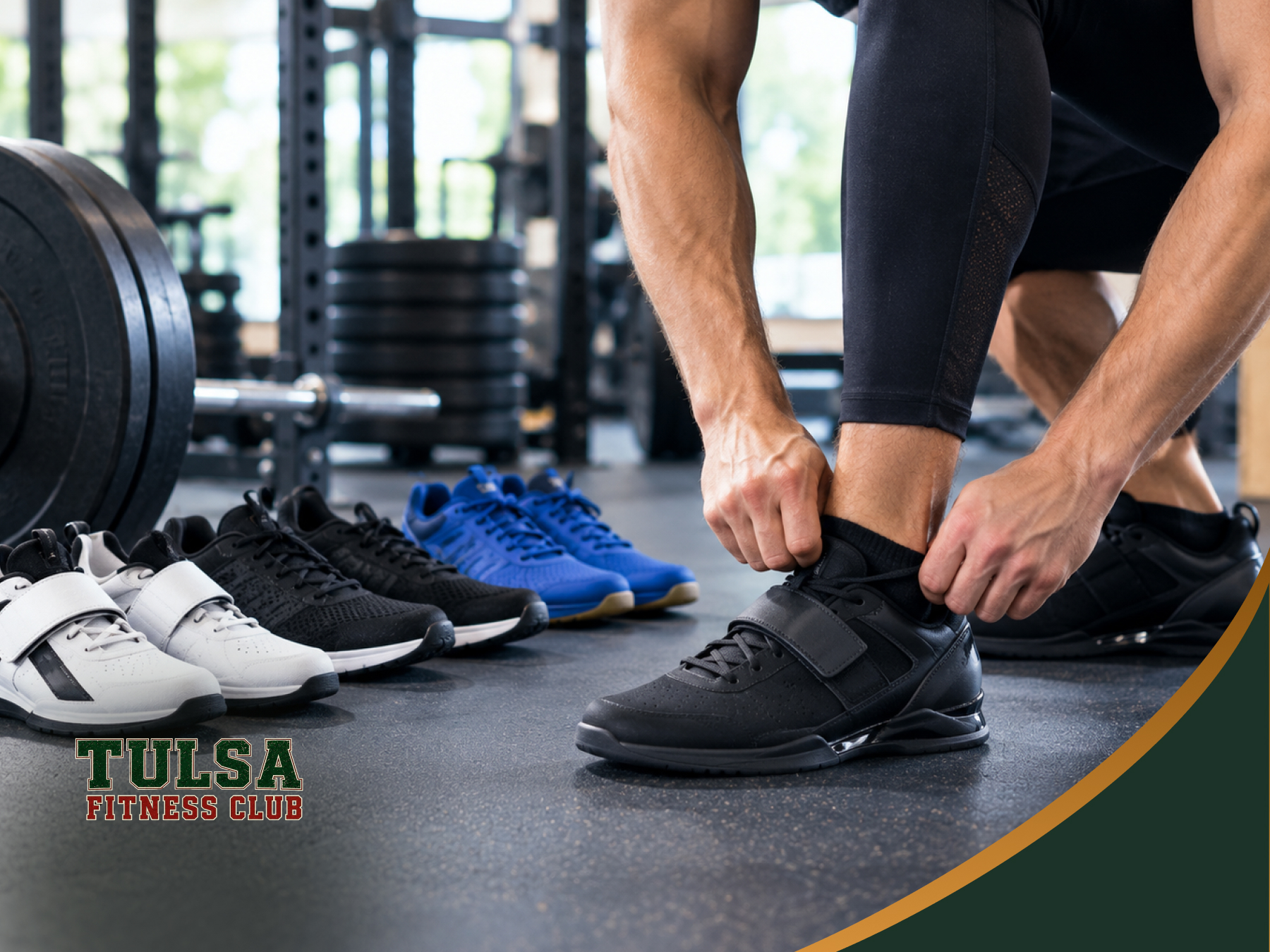
Walk onto the floor of any massive corporate fitness center, and you will see the exact same dangerous mistake happening in the squat racks. A member loads a heavy barbell onto their shoulders, steps back, and attempts to squat while wearing heavily cushioned, $200 running shoes.
Their ankles wobble, their knees cave inward, and they fail the lift—not because their muscles aren’t strong enough, but because their foundation is completely unstable.
If you are researching whether you need weightlifting shoes, the short answer is yes—but probably not the kind you think. Gym footwear is highly specialized equipment, and using the wrong tool for the job actively sabotages your strength gains and places your joints at risk.
At Tulsa Fitness Club (TFC) in the historic Blue Dome District, we prioritize heavy, foundational compound lifts. If you want to move real iron safely, you have to start from the ground up. Here is the brutally honest, biological breakdown of how to choose your gym footwear.
The Biology of Force Transfer
To understand footwear, you have to understand physics.
Running shoes are engineered for one specific purpose: absorbing impact. When your foot strikes the pavement, the thick foam midsole compresses to protect your joints from the shock.
But when you step under a heavy barbell, you do not want to absorb force—you want to generate it. When you try to squat or deadlift in running shoes, that thick layer of foam compresses unevenly under the heavy load. Your central nervous system detects this instability and immediately dials back your muscle recruitment to prevent injury. You are essentially trying to lift heavy weight while standing on a mattress.
To lift efficiently, you need a hard, non-compressible surface that allows 100% of your muscular force to transfer directly into the floor.
Generating interactive visual…Structuring code, this may take a minute
The Deadlift Protocol: Flat and Close to the Floor
When you are pulling a barbell off the floor for a conventional deadlift, your goal is to minimize the distance the bar has to travel and maximize your stability.
- The Solution: You need a completely flat, hard-soled shoe with zero drop (meaning the heel and the toe are at the exact same height).
- The Options: Classic canvas shoes like Converse Chuck Taylors or Vans are incredibly popular among powerlifters because they offer a hard rubber sole and zero cushioning. Alternatively, many serious lifters simply prefer to deadlift in their socks (or specialized lifting slippers) to get their feet as close to the floor as biologically possible, entirely eliminating the “squish” factor.
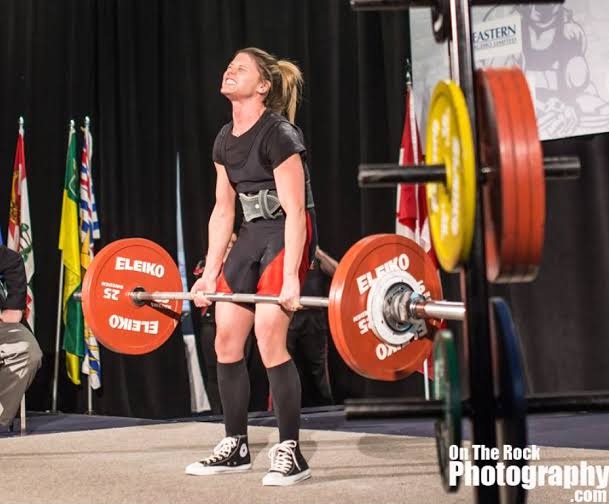
For the deadlift, the closer your feet are to the raw floor, the better. Hard-soled shoes or bare feet ensure maximum stability.. Source: Women Who Lift Weights
The Squat Protocol: The Case for the Elevated Heel
The barbell squat presents a completely different biomechanical challenge. To achieve a deep, safe squat where your hip crease drops below your knees, your ankles require a massive amount of dorsiflexion (the ability of your shin to travel forward over your toes).
Most modern adults sit at desks all day and have terrible ankle mobility. When they try to squat deep, their heels peel off the floor, throwing the weight forward onto their toes and dangerously straining their lower back.
- The Solution: Olympic weightlifting shoes.
- The Mechanics: These specialized shoes feature a rock-hard, non-compressible sole (often made of wood or dense TPU plastic) and a raised heel (typically 0.5 to 1 inch high). This artificial elevation immediately bypasses your ankle mobility restrictions. It allows your knees to track forward naturally, which in turn allows your torso to remain upright and your spine to stay protected under heavy loads.
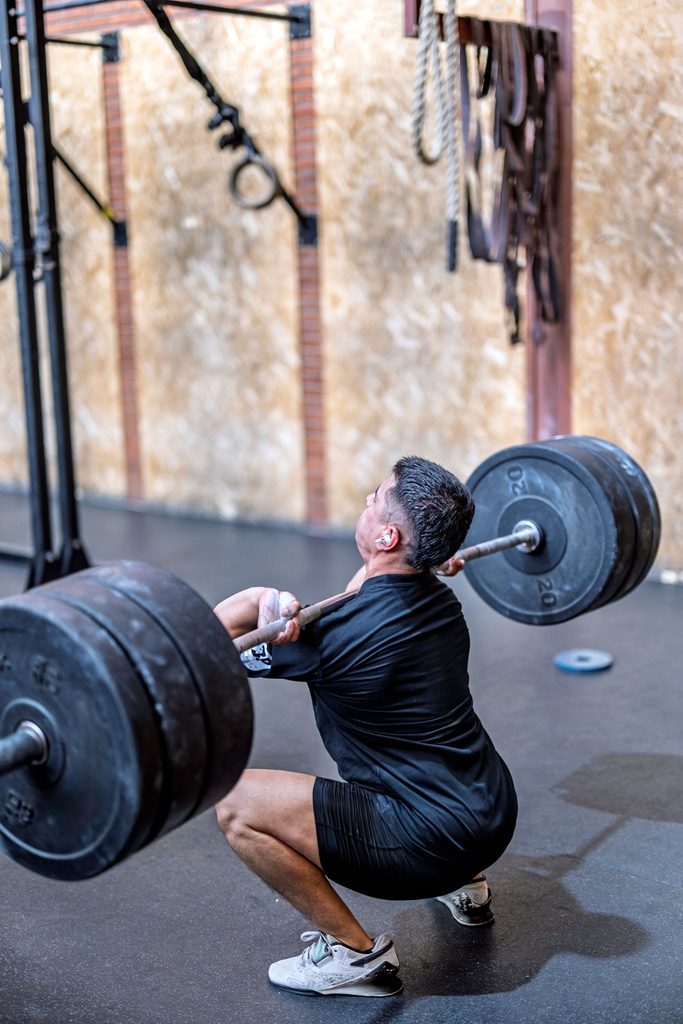
Notice the elevated heel on the specialized weightlifting shoe. This subtle geometry change allows the lifter to achieve maximum depth while keeping the torso safely upright.. Source: FelipeRodrguez1 / 500px / Getty Images
Explore the biomechanics of how an elevated heel directly alters your joint angles during a squat:
Generating interactive visual…Preparing high-resolution details
Key insight: You do not have to buy Olympic weightlifting shoes if you have elite, natural ankle mobility. But for 90% of the population, an elevated heel is the fastest, safest way to instantly improve your squat mechanics and protect your lumbar spine.
Train Where the Details Matter
Understanding the nuances of gym footwear is entirely pointless if you train in a facility that doesn’t respect the iron.
If you belong to a corporate mega-gym that bans deadlifting in socks or lacks the heavy-duty wooden platforms required for serious strength training, your environment is holding you back.
At Tulsa Fitness Club, we built a facility that caters to the dedicated professional. We prioritize multiple elite deadlift platforms, competition-grade power racks, and an environment where bringing a dedicated pair of lifting shoes is the standard, not the exception.
Built-In Coaching for Flawless Execution
If you aren’t sure whether your ankle mobility requires a weightlifting shoe, stop guessing. We baked elite coaching directly into our memberships:
- Bronze Tier ($47/mo — Presale $37/mo): Unrestricted 24/7 access to our heavy iron and platforms. Perfect for the independent lifter who already knows their gear.
- Silver Tier ($97/mo): 24/7 access plus expertly designed periodized programming templates that tell you exactly what lifts to execute.
- Gold Tier ($297/mo): The ultimate coaching replacement. Full access, premium coaching check-ins, and highly customized programming. Your TFC coach will review videos of your squat mechanics and tell you exactly whether an Olympic weightlifting shoe will fix your specific biomechanical bottlenecks.
The Presale Advantage: Right now, you can lock in our Founding Member Presale Rate starting at just $37/month(with your first month for only $1).
With the upcoming integration of our Catalyst Coworking space and Fuel Bar, TFC provides the ultimate downtown ecosystem. Execute a flawless, properly equipped heavy lifting block, grab a protein shake, and transition immediately into our secure Wi-Fi lounge for deep-focus professional work.
Stop squatting in running shoes. Upgrade your foundation, master your mechanics, and train in a facility that actually respects the work.
Call us at 918-550-5549 or drop by 314 E 3rd St., Tulsa, OK 74120 during staffed hours to tour the facility, pick up your secure 24/7 key fob, and lock in your membership before the presale ends. No contracts. Just absolute stability.