Gym Equipment Maintenance: What Members Should Look for Before Joining
When you walk into a commercial mega-gym for a prospective membership tour, the sales representative operates off a highly rehearsed script. They will walk you past the brightly lit lobby, show you the sparkling juice bar, point out the pristine rows of television screens mounted on the walls, and highlight the eucalyptus-infused towel service.
They want you to evaluate the facility based entirely on its superficial aesthetics. They want you to confuse “shiny” with “structurally sound.”
But if you are a driven athlete, a competitive powerlifter, or a serious professional running a periodized strength block, the lobby does not matter. The televisions do not matter. The only thing that dictates your physical progression and your bodily safety is the structural integrity of the heavy iron on the training floor.
The commercial fitness industry is notorious for spending millions of dollars on marketing campaigns while simultaneously slashing the budget for preventative maintenance. They will happily draft a $50 “Annual Facility Enhancement Fee” from your bank account while allowing their power racks to rust, their cables to fray, and their barbells to permanently bend under heavy loads.
Before you sign a 12-month contract and trust a facility with your central nervous system, you must conduct your own mechanical audit. At Tulsa Fitness Club (TFC), located at 314 E 3rd St. in the historic Blue Dome District, we believe in extreme ownership. We built a 24/7 strength sanctuary with competition-grade hardware, and we maintain it with absolute precision.
If you are tired of corporate neglect and dangerous equipment, here is the brutally honest, uncompromising gym equipment maintenance checklist you must execute before handing over your debit card.
1. The Danger of Neglect (The Biological Risk)
To understand why gym maintenance is so critical, you have to understand the sheer physics of what happens on a training floor.
When you sit on a padded recumbent bike and pedal slowly, an equipment failure is merely an annoyance. The pedal might stick, or the digital screen might flicker. You wipe it down and move on.
However, when you unrack a 315-pound barbell to execute a heavy back squat, or when you are pressing massive hex dumbbells directly over your face, you are placing incredible mechanical stress on the equipment and on your own skeletal structure. In the free-weight zone, an equipment failure is not an annoyance; it is a catastrophic biological risk.
- Shear Force and Catastrophe: If the locking pin on an adjustable bench fails while you are holding heavy weight, your spine absorbs the shock. If a frayed cable snaps during a heavy lat pulldown, the sudden loss of tension can tear your rotator cuff instantly.
- The Biomechanical Leak: Even if the equipment doesn’t completely snap, poorly maintained gear destroys your form. A bent barbell will aggressively rotate in your hands during a bench press, placing devastating shear force on your wrists and elbows.
You cannot push your physical limits in an environment where you do not implicitly trust the infrastructure.
2. The Ultimate Gym Equipment Maintenance Checklist
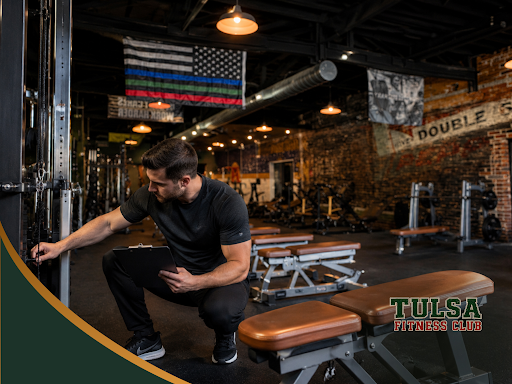
When the corporate sales rep leads you onto the floor, stop looking at the cardio machines and walk directly into the heavy free-weight section. You do not need to be a mechanical engineer to spot structural neglect. You just need to know exactly where to look.
Run this specific diagnostic checklist before you agree to a membership.
A. The Barbell Audit
The barbell is the most sacred tool in any strength facility. It is the primary instrument of biological adaptation. Corporate gyms buy cheap, low-tensile-strength barbells in bulk, and they almost never replace them.
- The Spin Test: Walk up to a barbell on a rack and rapidly spin the sleeves (the thick ends where the plates slide on). The sleeve should rotate smoothly with a low, consistent hum. If the sleeve grinds, catches, or refuses to spin, the internal bushings or bearings are completely shattered. Lifting with a seized sleeve places massive rotational torque directly onto your wrists during any pressing or pulling movement.
- The Straightness Check: Step back and look down the shaft of the barbell. Corporate bars are notorious for being permanently bent because cheap steel cannot handle the repeated stress of heavy rack pulls or dropped deadlifts. If a barbell is warped, it will actively try to roll out of your hands or off your back during a heavy set. It is useless.
- The Knurling Integrity: The knurling (the cross-hatched pattern cut into the steel for grip) should be distinct and aggressive. In poorly maintained commercial gyms, the knurling is often completely worn flat from years of abuse and lack of wire-brush cleaning, turning the bar into a slick, dangerous liability during a heavy deadlift.
B. The Power Rack Diagnostics
You cannot build absolute strength without a commercial power rack. It is your fortress. If the rack is structurally compromised, your safety is completely voided.
- The J-Cup Inspection: Look at the J-cups (the hooks that hold the barbell). A high-quality J-cup will be lined with thick UHMW plastic to protect the knurling of the barbell. In a neglected gym, this plastic is often completely worn away or missing, meaning it is bare steel grinding on bare steel. This destroys the equipment.
- The Safety Pin Check: Pull the safety pins or safety straps out of the rack and reinsert them. They should lock securely into place without excessive wiggling. If the rack holes are warped or the pins are bent, the rack has suffered an impact it wasn’t rated for.
- Structural Sway: Grab the vertical upright of the power rack and push it hard. It should feel like it is bolted to the earth. If the entire cage wobbles or sways, the 11-gauge steel bolts are loose, or the gauge of the steel is simply too thin to support heavy lifters.
C. The Flat Bench Integrity
The commercial bench press is where the highest percentage of upper-body injuries occur, largely due to atrocious equipment maintenance.
- The Wobble Test: Push laterally against the bench pad. A cheap or poorly maintained commercial bench will have a loose spine, causing the pad to wiggle side to side. When you are pressing heavy weight, any lateral instability will cause you to lose your scapular retraction, instantly exposing your shoulders to injury.
- The Vinyl Grip: Look at the upholstery. Corporate gyms use cheap, slick vinyl that turns into an ice rink when you sweat. If the vinyl is cracked, heavily taped with duct tape, or impossibly slick, you will never be able to maintain your back arch or leg drive.
D. The Cable and Pulley System
Cable machines provide continuous mechanical tension, but they are the most mechanically fragile items on the gym floor.
- Frayed Steel: Inspect the steel cables exactly where they loop over the pulleys and where they attach to the carabiners. If you see the rubber casing stripped away and the steel wires beginning to fray or splinter, walk away. That cable is a ticking time bomb.
- Pulley Tracking: Execute a few light repetitions on a cable crossover. The movement should be remarkably smooth. If the cable stutters, jumps, or grinds, the internal pulley wheels are cracked or have slipped off their tracks.
3. The “Out of Order” Corporate Epidemic
If you execute the gym equipment maintenance checklist at a massive commercial franchise, you will inevitably find broken equipment. But the true test of a facility is not whether something breaks—because in a high-volume strength environment, heavy use naturally leads to wear and tear.
The true test is the timeline of the repair.
The Corporate Bureaucracy
When a cable snaps or a treadmill motor burns out at a mega-gym, a front desk employee tapes a printed “Out of Order” sign to the machine. That sign will likely remain there for two to six months.
Why? Because a corporate gym is paralyzed by its own bureaucracy.
- The 20-year-old manager has to submit a maintenance ticket to a regional director.
- The regional director has to approve the budget to order the specific proprietary part from the corporate manufacturer.
- The gym has to wait for a third-party, underpaid corporate mechanic to fly in or drive across the state to install it.
They are actively trying to delay the repair to save on their quarterly operational budget.
The Annual Fee Insult
This delay is precisely why the hidden “Annual Enhancement Fee” is such an insult to the consumer. Corporate gyms automatically draft $50 to $70 from your checking account every year, claiming it is for “facility upkeep and new equipment.” Yet, you spend half the year staring at the exact same “Out of Order” sign on the only functional leg extension machine in the building. They are extracting maintenance revenue from you while actively refusing to execute the maintenance.
4. The TFC Standard: Extreme Ownership
At Tulsa Fitness Club, we view the corporate maintenance model with absolute disgust. We built a gritty, old-school barbell club for adults who demand respect.
When you build a facility for driven professionals, competitive powerlifters, and serious athletes, you cannot afford a six-week lag time on a broken bench. We operate on a philosophy of extreme ownership.
Buy Once, Cry Once (Commercial-Grade Iron)
The first step to impeccable maintenance is buying equipment that is inherently difficult to destroy.
We stripped out the cheap, plastic corporate machines and over-indexed massively on the heavy iron. We supply multiple heavy-duty, 11-gauge steel power racks. We bought competition-spec benches with thick, grippy upholstery that locks your shoulder blades in place. We stocked our racks with calibrated plates and heavy hex dumbbells that scale far beyond the 50-pound commercial limit.
When you invest in elite, competition-grade infrastructure, the rate of mechanical failure drops to near zero.
Immediate Action
Because TFC is privately owned and fiercely protected, there is no regional director to email, and there is no corporate budget to argue over. If a barbell bearing starts to stick, or if a safety pin bends, it is pulled from the floor immediately and replaced or repaired. We respect the work you put in, and we ensure the tools you need are always fully operational.
5. Autonomy and the 24/7 Professional
Flawless equipment maintenance is not just a luxury; it is a vital necessity for the 24/7 lifter.
Your central nervous system does not operate on a corporate 9-to-5 schedule. If you are a driven entrepreneur, a medical shift worker, or an executive living in the Deco District or East Village, your schedule dictates when you train.
Every TFC member is issued an encrypted digital key fob granting unrestricted 24/7 access to the facility, 365 days a year. We do not close the heavy free-weight section at night, and we do not restrict weekend hours.
If you are executing a massive, two-hour barbell squat session in complete silence at 3:30 AM before a massive board meeting, there is no manager on duty to spot you. You are entirely alone with the iron.
In that scenario, you must possess absolute, uncompromising trust in the safety pins of your power rack and the structural integrity of your barbell. At TFC, our extreme maintenance protocols ensure that your 3:00 AM solo session is as safe and structurally sound as a mid-day workout.
6. The Downtown Ecosystem (Beyond the Weights)
Our standard of extreme ownership and cleanliness does not stop at the edge of the deadlift platforms.
Commuting endlessly between a gritty barbell club, a downtown loft, and a local coffee shop burns massive amounts of your limited daily energy. We consolidated your routine by integrating our Catalyst Coworking space and the on-site TFC Fuel Bar directly into the facility layout.
- The Showers: Corporate gyms often treat their locker rooms as an afterthought, leading to unsanitary, poorly maintained shower facilities. At TFC, our private showers are maintained with the exact same rigor as our power racks. They are clean, functional, and ready for the professional.
- The Coworking Lounge: You can execute a brutal lifting block, hit the clean showers, grab a high-protein recovery shake from the Fuel Bar, and transition immediately into our secure Wi-Fi coworking lounge. You can knock out a morning of deep-focus professional work in a highly energized, meticulously maintained environment without ever leaving the building.
7. Built-In Coaching (Mastering the Equipment)
Even the most perfectly maintained equipment is dangerous if you do not know how to sequence it correctly. If you are returning to heavy lifting and want to ensure you are utilizing the commercial-grade infrastructure safely, we baked elite coaching directly into our transparent pricing tiers.
We do not ambush you with $80-an-hour personal training upsells.
- The Bronze Tier: The Independent Iron ($47/month) Unrestricted 24/7 access to the heavy iron, the massive dumbbell racks, the Catalyst Coworking space, and the dedicated platforms. Perfect for the independent lifter who already knows their programming.
- The Silver Tier: The Blueprint ($97/month) If you are tired of spinning your wheels, the Silver Tier provides 24/7 access plus expertly designed, periodized programming templates. We outline exactly how to structure your main barbell lifts to safely rebuild your central nervous system’s capacity for load.
- The Gold Tier: The Executive Partnership ($297/month) The ultimate coaching replacement for the driven adult. You receive full Silver access, plus highly customized programming tailored to your specific biomechanics, injury history, and schedule. Your TFC coach tracks your metrics and reviews your lifting videos to ensure your free-weight mechanics are absolutely flawless.
8. The Ultimate Test: The Presale Advantage
We believe the absolute best way to execute a gym equipment maintenance checklist is to put your hands on the iron yourself, without the threat of a predatory 12-month contract hanging over your head.
You have to feel the aggressive knurling of the barbells, test the stability of the power racks, and experience the grip of a true competition bench to understand the massive difference between a corporate spa and a true strength sanctuary.
Right now, you can lock in our Founding Member Presale Rate starting at just $37/month for the Bronze Tier (with your first month for only $1).
You pay your dollar, you sign a waiver, and you get immediate, 24/7 access to the heavy iron. Because we require zero contracts and charge zero hidden maintenance fees, you are completely free to cancel if the gritty, old-school environment isn’t the right fit for your routine.
Stop subsidizing the broken equipment of the commercial fitness machine. Demand access to real, heavy iron, secure your absolute pricing transparency, and train in a gritty, downtown facility that respects the intense work you put in.
Call us at 918-550-5549 or drop by our location at 314 E 3rd St., Tulsa, OK 74120 during our staffed hours to tour the facility, pick up your secure 24/7 key fob, run your own equipment diagnostic, and lock in your Founding Member pricing before the presale ends.