Powerlifting Gym in Tulsa: Racks, Bars, and Plates to Look For.
The commercial fitness industry has completely bastardized the barbell.
If you walk into a standard corporate mega-gym and ask to see their powerlifting equipment, they will inevitably point you toward a flimsy, aluminum-coated barbell resting on a half-rack next to the ellipticals. To the casual gym-goer, a barbell is just a piece of metal. But to a powerlifter, a barbell is a precision instrument designed to transfer hundreds of pounds of mechanical force directly into the central nervous system.
When your goals shift from “breaking a light sweat” to “adding 50 pounds to your competition total,” you cannot train in a facility that buys its equipment out of a budget catalog. The infrastructure of your gym dictates your absolute strength potential.
If you are a serious strength athlete searching for a true powerlifting gym in Tulsa, you have to know exactly what you are looking at when you tour a facility. You cannot settle for cheap steel, thick bumper plates, or slick benches.
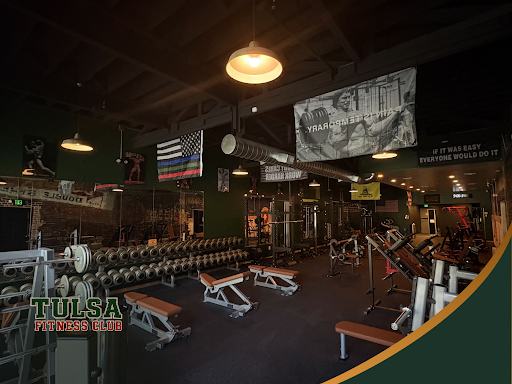
At Tulsa Fitness Club (TFC), located at 314 E 3rd St. in the historic Blue Dome District, we actively rejected the commercial cardio model. We engineered a 24/7 strength sanctuary specifically for the driven lifter. We over-indexed on the heavy iron.
If you want to stop spinning your wheels on inferior equipment, here is the brutally honest, biomechanical breakdown of the racks, bars, and plates you must demand from a serious powerlifting facility.
The Hardware Spec: Barbells (Stiffness and Knurling)
The most glaring biological crime committed by corporate health clubs is the quality of their barbells.
Commercial gyms purchase cheap, 30mm or 32mm generic barbells. These bars are thick, smooth, and designed to limit liability. Because they are cheaply made, they develop a massive amount of “whip” (the bouncing effect of the bar bending under a load). If you unrack 405 pounds for a heavy back squat on a cheap, whippy barbell, the bar will literally bounce on your back as you descend, completely destroying your core bracing and throwing your center of gravity forward.
A serious powerlifting facility provides true, competition-grade power bars.
The 29mm Requirement A true power bar is machined to exactly 29 millimeters in diameter. It is forged from high-tensile steel designed to be incredibly stiff. When you unrack 500 pounds, a power bar does not bend or whip. It remains rigid, ensuring that 100% of your muscular force transfers directly through the floor and into the weight, rather than being absorbed by the flex of the steel.
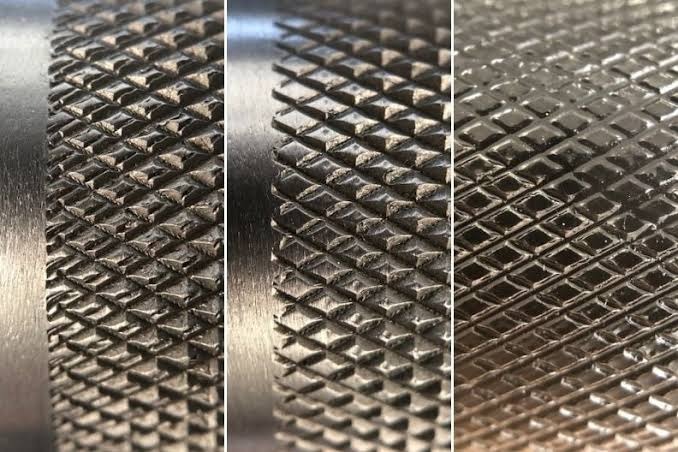
Commercial gyms use passive, smooth knurling to protect casual members’ hands. Powerlifting requires aggressive, mountain-pattern knurling to lock the barbell into your grip and back.. Source: Garage Gym Lab
Aggressive Knurling and the Center Knurl Commercial gym barbells are slick. They use a “passive” knurling pattern so casual members don’t get calluses.
In powerlifting, calluses are the price of admission. A true power bar features highly aggressive, deep-cut “mountain” knurling. During a heavy deadlift, this aggressive knurling bites into your skin, creating absolute friction and locking the bar into your hands so your grip does not fail before your hamstrings do.
Furthermore, a true power bar must have a center knurl. When you position the barbell across your rear deltoids for a heavy low-bar squat, that center knurling bites into the fabric of your shirt, locking the bar in place. Without a center knurl, a heavy barbell will violently slide down your back during the eccentric phase of the squat, risking catastrophic spinal injury.
At TFC, we stock competition-grade power bars, deadlift bars, and specialty tools like Safety Squat Bars (SSB) and Trap bars to ensure your mechanical execution is never compromised by the steel in your hands.
The Hardware Spec: Power Racks and Rigging
You cannot execute a maximal-effort lifting block if you are terrified that the rack is going to collapse.
Corporate gyms use cheap “half-racks.” These are lightweight, unbolted aluminum structures that tip backward if you re-rack a heavy weight too aggressively. They use shallow, plastic J-cups that make it nearly impossible to lift the bar cleanly, and they offer zero safety mechanisms if you fail a lift.
11-Gauge Steel and Floor Anchoring A true powerlifting gym utilizes heavy-duty, commercial power racks built from 3×3 inch, 11-gauge steel. More importantly, these racks are physically bolted directly into the concrete foundation of the building. When you aggressively re-rack a 600-pound squat, the rack should not budge a single millimeter.
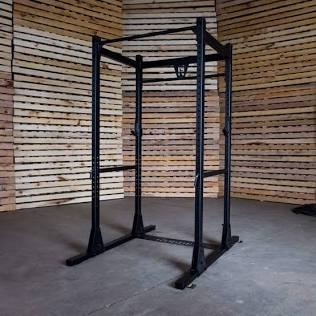
Do not trust a heavy squat to a flimsy, unbolted commercial half-rack. Serious force production requires 11-gauge steel bolted directly into the foundation.. Source: Best Fitness Equipment
Adjustable Safety Pins and J-Cups When you are pushing your central nervous system to absolute failure, you need the psychological security of safety pins.
Commercial gyms either lack safeties entirely or space the pin holes six inches apart, making it impossible to find the correct depth for your specific biomechanics. A powerlifting rack features pin holes spaced exactly one inch apart (often referred to as Westside hole spacing) through the bench press and squat zones. This allows you to set the safety pins exactly one inch below your deepest range of motion, allowing you to train to absolute failure without requiring a spotter.
The Hardware Spec: Calibrated Plates vs. Thick Bumpers
If you want to immediately identify whether a gym caters to powerlifters or casuals, look at the weight plates.
Corporate gyms and generic cross-training boxes love to use massively thick, recycled rubber bumper plates. For Olympic weightlifting (where the barbell is dropped from overhead), thick bumpers are necessary. But for powerlifting, they are a mathematical disaster.
If you load a standard barbell with thick, commercial bumper plates, you will physically run out of room on the sleeve of the barbell at exactly 405 pounds. If your program calls for a 455-pound deadlift, you literally cannot fit the weight onto the bar.
The Necessity of Thin Steel Powerlifting requires dense, thin plates. At a minimum, a facility must supply thin, machined cast-iron plates.
However, elite powerlifting gyms provide calibrated steel plates. These plates are machined to microscopic tolerances (accurate to within 10 grams of their stated weight) and are incredibly thin. This thin profile keeps the center of mass as close to the center of the barbell as possible, reducing unnatural whip and allowing an athlete to load upwards of 800+ pounds onto a single barbell sleeve.
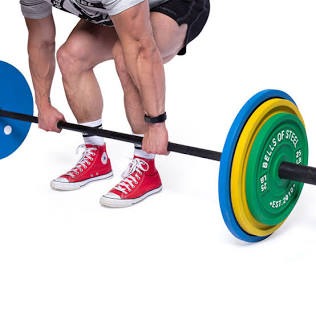
Thick rubber bumper plates max out the barbell sleeve too quickly. To pull serious weight, you need the thin profile and precise accuracy of calibrated steel plates.. Source: Bells of Steel
When you train at a facility that provides competition-grade plates, you are lifting the exact same equipment you will face on the platform on meet day. There is zero transition friction.
The Hardware Spec: The Bench Press Command Center
The bench press is the most butchered movement in the commercial fitness industry, largely because commercial gyms use terrible benches.
A corporate gym bench is typically 10 inches wide, coated in slick, cheap vinyl, and sits nearly 20 inches off the floor.
When you execute a heavy bench press, you must forcefully retract and depress your scapulae (shoulder blades) to create a stable base, while driving your feet into the floor for leg drive. On a narrow, slick commercial bench, your shoulder blades will literally slide off the edges of the pad, completely destroying your shoulder stability and leaking massive amounts of force.
The Competition Bench A proper powerlifting bench is built to competition specifications.
- The Pad: The pad must be at least 12 to 12.5 inches wide, allowing your entire scapular structure to dig into the foam.
- The Material: The upholstery must be a highly textured, grippy material (often a specialized vinyl or textured polyurethane) that prevents your shoulders from sliding backward when you initiate leg drive.
- The Height: The bench should sit exactly 17 inches from the floor, allowing athletes to plant their feet flat and drive force through their hips without their glutes leaving the pad.
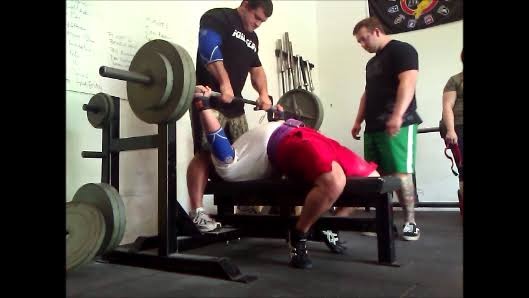
A commercial gym bench is too narrow and too slick. A competition bench is wide and grippy, allowing you to lock your scapulae in place for maximum force transfer.. Source: PowerliftingToWin
The TFC Ethos: 24/7 Autonomy and the Downtown Ecosystem
Having the right hardware is only half the battle. The other half is logistics.
If you are running a heavy 12-week peaking block for a powerlifting meet, your workouts are going to take time. A proper strength session involving heavy squats, accessory work, and mobility drills can easily take 90 to 120 minutes.
You cannot execute a 2-hour workout at a corporate gym that closes at 9:00 PM, and you certainly cannot do it effectively if you have to wait in line for a squat rack.
At Tulsa Fitness Club, your schedule never dictates your progression. Every member is issued an encrypted digital key fob granting unrestricted 24/7 access to the facility, 365 days a year. If you need to hit a massive bench press session at 3:00 AM before a brutal workday, you possess absolute autonomy over your training environment.
The Ultimate Professional Integration: Catalyst Coworking
Most powerlifters are highly driven professionals outside of the gym. We recognized that commuting between the gym, your downtown apartment, and your office burns time and mental energy.
We integrated the Catalyst Coworking space and the on-site TFC Fuel Bar directly into the facility to create the ultimate daily hub for the Tulsa Arts District and Blue Dome District local.
You can walk to the facility, execute a brutal 2-hour heavy lifting block, and hit the private showers. You can grab a high-protein recovery shake from the Fuel Bar to instantly spike muscle protein synthesis, and transition immediately into our secure Wi-Fi coworking lounge. You can execute your physical programming and your professional workload in one seamless, high-energy environment.
Lock In Your Membership (No Predatory Contracts)
Corporate gyms survive by locking casual members into 12-month contracts they cannot escape. At TFC, we retain our members by providing elite, heavy-duty equipment and a culture of absolute execution. We operate on a strict, transparent, no-contract basis.
If you are ready to abandon the commercial cardio rooms and graduate to a facility that respects the iron, we offer three distinct tiers:
The Bronze Tier: The Independent Iron ($47/month) Unrestricted 24/7 access to the heavy iron, the power racks, and the dedicated platforms. It is the perfect tier for the independent powerlifter who already has their peaking program dialed in and simply needs the commercial-grade hardware to execute it.
The Silver Tier: The Blueprint ($97/month) If you are transitioning into serious strength training and need a roadmap, the Silver Tier provides 24/7 access plus expertly designed, periodized programming templates. We outline exactly how to structure your main lifts and accessory movements to ensure progressive overload without frying your central nervous system. You also receive a monthly InBody Scan to track your precise body composition, and a 25% discount at the Fuel Club.
The Gold Tier: The Executive Partnership ($297/month) The ultimate coaching replacement for the driven athlete. You receive full Silver access, plus highly customized programming tailored to your specific biomechanics, meet schedule, and injury history. Your TFC coach reviews your lifting videos to correct your form, adjust your bracing mechanics, and fine-tune your joint angles to maximize your competition total.
The Presale Advantage: Right now, you can lock in our Founding Member Presale Rate starting at just $37/monthfor the Bronze Tier (with your first month for only $1).
Stop trusting your heavy lifts to cheap, unbolted commercial equipment. Demand access to stiff power bars, 11-gauge steel, and calibrated plates. Train in a gritty, downtown facility that demands your best effort.
Call us at 918-550-5549 or drop by our location at 314 E 3rd St., Tulsa, OK 74120 during our staffed hours to tour the facility, pick up your secure 24/7 key fob, and lock in your Founding Member pricing before the presale ends.