Compound vs Isolation Exercises: What’s the Difference?
If you only have 45 minutes to train on your lunch break, your exercise selection dictates whether you are building genuine strength or simply wasting your time.
Walk onto any commercial gym floor, and you will see a stark divide in how people train. On one side, lifters are loading heavy barbells, executing squats, deadlifts, and presses. On the other side, people are sitting on padded machines, carefully extending their legs or curling a single dumbbell while scrolling through their phones.
This divide represents the fundamental difference between compound and isolation exercises.
In the fitness industry, neither type of movement is inherently “bad,” but treating them as equals is a biological mistake. If you want to force your body to adapt, build dense muscle tissue, and optimize your limited time, you have to understand the specific role each plays in your programming.
At Tulsa Fitness Club (TFC) in the historic Blue Dome District, our facility is engineered around efficiency and heavy iron. If you are tired of spending two hours in the gym with zero results, here is the brutally honest, science-backed breakdown of compound vs isolation exercises and how to sequence them for maximum impact.
What Are Compound Exercises? (The Builders)
A compound exercise is any movement that requires multiple joints and multiple muscle groups to work together simultaneously to move a load.
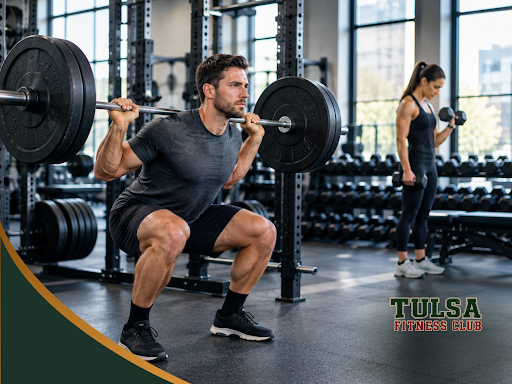
When you perform a Barbell Back Squat, your hips, knees, and ankles are all flexing and extending. Your quads, hamstrings, and glutes are firing to move the weight, while your spinal erectors and abdominal core are working in overdrive just to keep your torso from collapsing.
Examples of Compound Exercises:
- Barbell Squat (Legs, Glutes, Core)
- Conventional Deadlift (Hamstrings, Back, Forearms, Core)
- Bench Press (Chest, Shoulders, Triceps)
- Overhead Press (Shoulders, Triceps, Upper Chest, Core)
- Pull-Ups (Lats, Biceps, Rhomboids)
The Biological Benefit of Compounds
Compound movements are the absolute foundation of human strength because they trigger a massive central nervous system (CNS) response. By recruiting a massive amount of muscle mass simultaneously, you can lift significantly heavier weights. This heavy mechanical tension is the primary driver of muscle hypertrophy (growth) and bone density. Furthermore, heavy compounds trigger a natural spike in anabolic hormones (like testosterone and human growth hormone) that isolation exercises simply cannot match.
If you want to build a powerful physique efficiently, 80% of your gym time should be spent here.
The Deadlift is the ultimate compound movement, recruiting almost every muscle from your calves to your traps to execute a single, heavy pull.. Source: Vecteezy
What Are Isolation Exercises? (The Sculptors)
An isolation exercise is any movement that targets a single joint and a single muscle group.
When you perform a Dumbbell Bicep Curl, only your elbow joint is moving. The mechanical tension is isolated almost entirely onto the biceps brachii, removing the chest, back, and legs from the equation.
Examples of Isolation Exercises:
- Dumbbell Bicep Curls (Biceps)
- Leg Extensions (Quadriceps)
- Tricep Cable Pushdowns (Triceps)
- Lateral Raises (Side Deltoids)
- Hamstring Curls (Hamstrings)
The Biological Benefit of Isolation
Because isolation exercises only use one muscle group, you cannot lift heavy weight. However, they are incredibly valuable for specific purposes. Isolation movements are the ultimate tool for correcting muscular imbalances. If your left quad is noticeably weaker than your right quad following an injury, compound squats will naturally favor your strong leg. A single-leg extension machine forces the weak leg to do the work.
Additionally, isolation exercises are fantastic for generating “metabolic stress” (the pump) without frying your central nervous system. You can take a bicep curl to absolute muscular failure without risking a catastrophic spinal injury.
Isolation exercises like the concentration curl allow you to target a specific muscle group with pinpoint accuracy, perfect for fixing imbalances and finishing a workout.. Source: Myprotein AU
Was this visual helpful?
Yes No
The Blueprint: How to Sequence Your Workout
The biggest mistake beginners make is reversing the order of these exercises. If you fatigue your single muscle groups first, you ruin your ability to lift heavy.
Here is the exact biological sequence you must follow to optimize your training:
1
Step 1: Heavy Compounds First
The priority
Always start your workout with your heaviest, most demanding compound lift (e.g., the Bench Press or Deadlift) while your central nervous system is completely fresh and your glycogen stores are full. Execute 3 to 5 heavy sets.
2
Step 2: Accessory Compounds
Secondary volume
Follow your primary lift with a secondary compound movement that supports it. If you benched first, follow it with Incline Dumbbell Presses or Dips. Use slightly lighter weight and higher reps (8 to 12).
3
Step 3: Isolation Finishers
The burnout
At the end of your workout, when your CNS is tired but you still want to push specific muscles to failure, execute your isolation exercises. This is the time for bicep curls, tricep pushdowns, and lateral raises.
The Commercial Gym Problem
Why do so many people default to isolation machines? Because commercial mega-gyms are designed to encourage it.
Corporate fitness centers pack their floors with fixed-path isolation machines because they are less intimidating to beginners, require zero coaching to use, and present a lower liability risk than free-weight barbells.
But if you spend your entire hour hopping from a seated chest press machine to a seated leg extension machine, you are missing out on the core stabilization, hormonal response, and raw strength adaptations that only heavy iron can provide.
To execute a proper compound-first program, you need an environment built for barbells, not just padded seats.
The TFC Solution: Built for the Heavy Iron
At Tulsa Fitness Club, we actively stripped out the commercial gym fluff. We are a strength sanctuary designed for professionals who want to execute their programs flawlessly and efficiently.
1. Equipment Built for Compounds
We prioritize the exact equipment that causes traffic jams at corporate gyms. With multiple heavy-duty power racks, dedicated deadlift platforms, and competition-grade barbells, you never have to wait in line to hit your primary compound lifts. We also provide the heavy hex dumbbells and cable stacks necessary to execute your isolation finishers perfectly.
2. Built-In Coaching (Stop Guessing Your Routine)
If you are tired of wondering which compound lift to pair with which isolation exercise, we integrated elite programming directly into our flat-rate memberships.
- Bronze Tier ($47/mo — Presale $37/mo): Unrestricted 24/7 access to our heavy iron. Perfect for the independent lifter who already has their compound/isolation split dialed in.
- Silver Tier ($97/mo): 24/7 access plus expertly designed periodized programming templates. We tell you exactly how to sequence your heavy compounds and isolation finishers to force progressive overload.
- Gold Tier ($297/mo): The ultimate coaching replacement. Full access, highly customized programming, and premium coaching check-ins. Your TFC coach tracks your metrics and reviews your heavy compound form via video to ensure you are lifting safely and effectively.
The Presale Advantage: Right now, you can lock in our Founding Member Presale Rate starting at just $37/month(with your first month for only $1).
Furthermore, consistency is about integration. With the upcoming launch of our Catalyst Coworking space and Fuel Bar, you can execute a heavy, compound-focused lifting block, grab a protein shake to fuel your recovery, and transition immediately into our secure Wi-Fi lounge for deep-focus professional work.
Stop wasting your lunch break on isolation machines. Prioritize the heavy iron, force your body to adapt, and train in a facility that respects the work.
Call us at 918-550-5549 or drop by 314 E 3rd St., Tulsa, OK 74120 during staffed hours to tour the facility, secure your digital key fob, and lock in your Founding Member pricing before the presale ends.