How to Breathe When Lifting Weights: The Science of Bracing
The most common piece of advice handed out by commercial personal trainers is to “exhale on the effort.”
If you are sitting on a padded machine doing light leg extensions, that advice is perfectly fine. But if you apply that exact same breathing technique to a heavy barbell back squat, you are actively inviting a catastrophic spinal injury. If you exhale at the bottom of a heavy squat, your core deflates, your spine loses its internal support structure, and you collapse under the iron.
Breathing during serious strength training is not about getting oxygen to your muscles; it is about creating structural armor.
At Tulsa Fitness Club (TFC) in the historic Blue Dome District, we prioritize heavy compound movements. If you want to move real weight safely and efficiently, you have to stop chest-breathing and master the mechanics of intra-abdominal pressure. Here is the brutally honest, biological breakdown of exactly how you should be breathing when you step up to the barbell.
The Valsalva Maneuver: Armor for Your Spine
When you execute a heavy squat, deadlift, or overhead press, your spine is subjected to massive compressive forces. The muscles in your lower back are not strong enough to support that load alone. You must turn your entire torso into a rigid cylinder.
In sports science, this is known as the Valsalva maneuver. It relies on expanding the diaphragm downward to trap air and increase pressure inside your abdominal cavity.
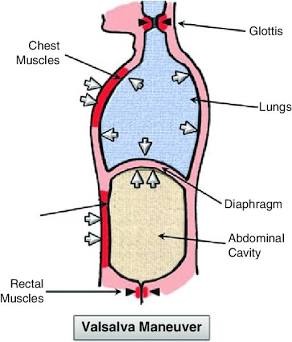
When you breathe deeply into your belly and brace, you create an internal pocket of pressure that acts as a physical shock absorber for your lumbar spine.. Source: ResearchGate
Here is exactly how to execute it on a heavy lift:
1
The 360-Degree Belly Breath
Do not lift your shoulders
Before you unrack the weight or initiate the pull, take a massive breath—but do not breathe into your chest. Pull the air deep into your stomach. You should feel your belly, obliques, and lower back expand outward in a full 360-degree circle.
2
The Brace
Lock the cylinder
Once your belly is full of air, close your glottis (the back of your throat) so no air can escape. Now, flex your entire abdominal wall exactly as you would if someone were about to punch you in the stomach. You have just created maximum intra-abdominal pressure.
3
Execute the Repetition
Maintain the tension
Keep the air trapped and your core aggressively flexed as you perform the hardest part of the movement (e.g., descending into the squat and driving back out of the hole). Do not let a single ounce of air leak out.
4
Exhale at the Top
Reset for the next rep
Once you have successfully pushed past the “sticking point” (the hardest part of the lift) and are returning to a standing or locked-out position, you can forcefully exhale. Take another deep belly breath and re-brace before initiating the next rep.
Generating interactive visual…Structuring code, this may take a minute
When to Use “Normal” Breathing
You do not need to use the Valsalva maneuver for every single exercise. In fact, holding your breath during a high-rep set of bicep curls will just spike your blood pressure and make you dizzy for no biological benefit.
You must match your breathing technique to the mechanical demand of the exercise:
- Heavy Compound Lifts (1 to 6 Reps): Squats, Deadlifts, Heavy Rows, Overhead Presses, and heavy Bench Presses require the Valsalva maneuver. Absolute structural rigidity is mandatory.
- Isolation and Machine Work (8+ Reps): Bicep curls, leg extensions, lateral raises, and lat pulldowns do not load the spine heavily. For these, use continuous breathing. Inhale during the eccentric (lowering) phase, and exhale smoothly during the concentric (pushing/pulling) phase.
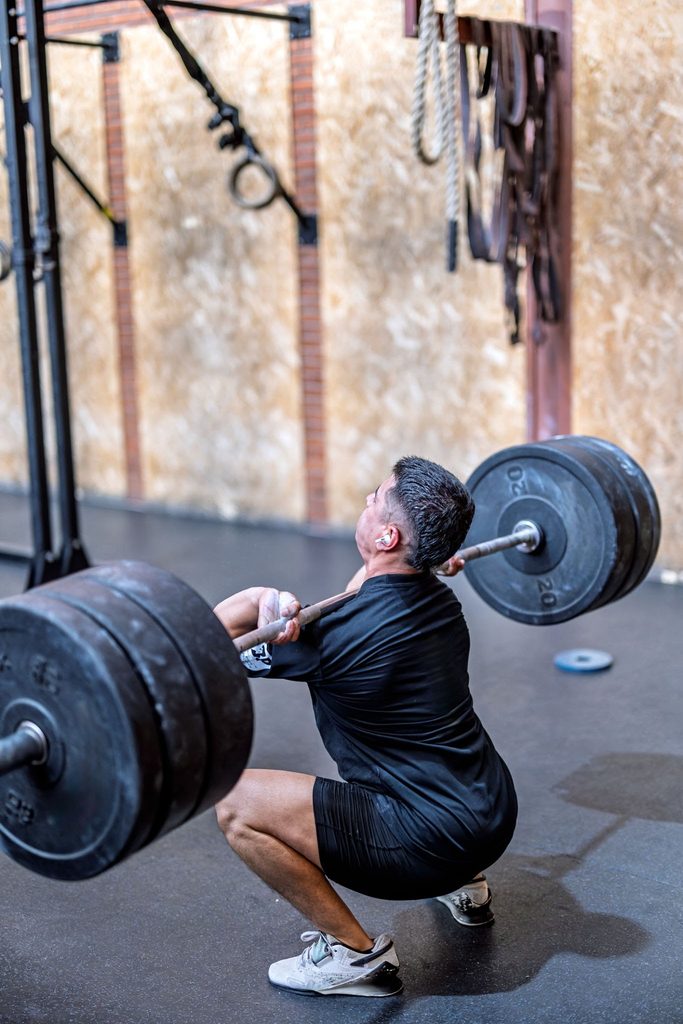
On a heavy barbell squat, your breath is your lifting belt. A massive diaphragmatic inhale and a locked core provide the leverage needed to move heavy iron.. Source: FelipeRodrguez1 / 500px / Getty Images
Why the Commercial Gym Fails the Heavy Lifter
Most commercial mega-gyms are filled with padded machines that do the stabilizing for you. Because you are sitting down with your back supported by a cushion, learning how to brace your core and breathe correctly is completely unnecessary.
This creates a false sense of security. When a commercial gym member finally decides to try a free-weight barbell squat, they have no idea how to generate intra-abdominal pressure, resulting in an immediate lower back injury.
To build genuine, functional strength, you need an environment that demands perfect mechanics and provides the equipment necessary to execute them.
The TFC Solution: Train With Precision
At Tulsa Fitness Club, we stripped out the commercial resort fluff and built a facility dedicated to serious progressive overload. We prioritize heavy-duty power racks, deadlift platforms, and competition-grade iron.
Because we focus on heavy compound movements, we take mechanics—like the Valsalva maneuver—seriously.
If you are tired of guessing your technique, we integrated elite professional coaching directly into our transparent memberships:
- Bronze Tier ($47/mo — Presale $37/mo): Unrestricted 24/7 access to our heavy iron. The perfect tier if you already know how to brace and just need the power racks to execute your program without waiting in line.
- Silver Tier ($97/mo): 24/7 access plus expertly designed periodized programming templates. We outline exactly when to push heavy compounds (where you need to brace) and when to hit isolation volume (where you breathe normally).
- Gold Tier ($297/mo): The ultimate coaching replacement. Full access, highly customized programming, and premium coaching check-ins. You record your heavy lifts, and a professional TFC strength coach reviews your video specifically to ensure you are inhaling, bracing, and holding your tension correctly before you initiate the lift.
The Presale Advantage: Right now, you can lock in our Founding Member Presale Rate starting at just $37/month(with your first month for only $1).
Furthermore, TFC is rapidly becoming the ultimate hub for the driven professional. With the upcoming launch of our Catalyst Coworking space and Fuel Bar, you can execute a flawless heavy lifting block, grab a protein shake, and transition immediately into our secure Wi-Fi lounge to knock out an hour of deep-focus work.
Stop exhaling at the bottom of your squat. Master your breath, lock in your core, and train in a facility that respects the iron.
Call us at 918-550-5549 or drop by 314 E 3rd St., Tulsa, OK 74120 during staffed hours to tour the facility, pick up your secure 24/7 key fob, and lock in your Founding Member pricing before the presale ends.