How to Set Up a Squat Rack: A Step-by-Step Guide
The power rack is the most vital piece of real estate in any serious strength facility. It is where you build genuine, total-body strength through heavy compound movements. But for a beginner, a massive steel cage with movable hooks, pins, and levers can look incredibly intimidating.
Many commercial gym-goers avoid the barbell back squat entirely simply because they do not know how to set up a squat rack. Instead, they default to fixed-path machines, sacrificing massive muscle growth and core stability just to avoid looking like a rookie on the gym floor.
At Tulsa Fitness Club (TFC) in the historic Blue Dome District, we believe that mastering your equipment is the first step in mastering your physique. We prioritize heavy-duty power racks over endless rows of ellipticals, and we expect our members to know how to use them with precision.
If you are ready to step away from the machines and get under the heavy iron, here is your definitive, no-nonsense guide to configuring a squat rack for maximum safety and mechanical efficiency.
The Anatomy of the Power Rack
Before you start pulling levers, you need to know the terminology. A standard power rack consists of four vertical steel uprights and two primary adjustable components:
- The J-Hooks: The heavy steel brackets that hold the barbell. They are shaped like a “J” to prevent the bar from rolling off.
- The Safeties (Pins or Straps): The horizontal steel bars or heavy-duty nylon straps that run parallel to the floor inside the cage. They act as your mechanical spotter if you fail a lift.
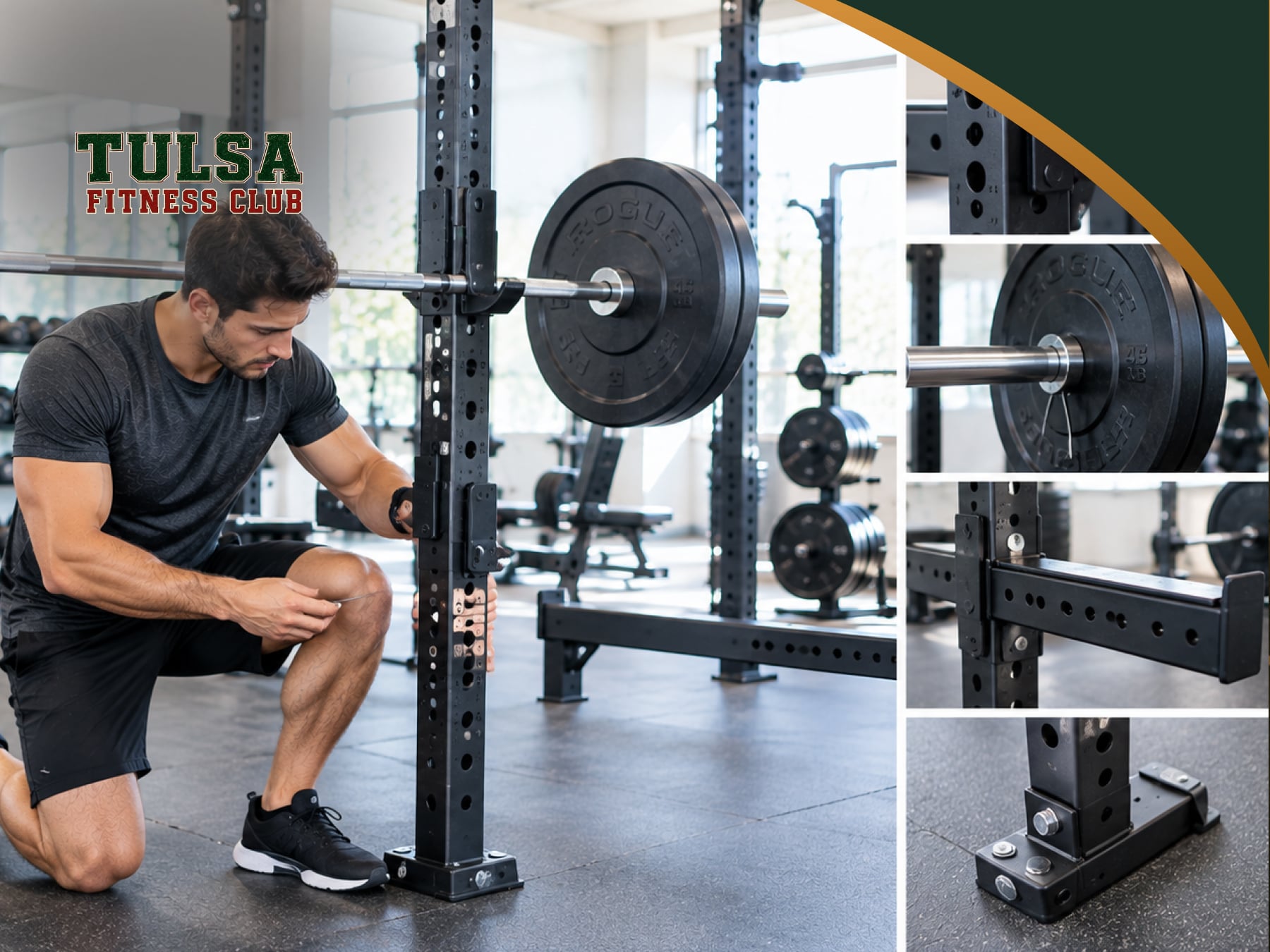
Familiarize yourself with the J-hooks and safety pins before loading any weight onto the barbell.. Source: eBay
How to Set Up a Squat Rack: The Execution
Setting up the rack incorrectly doesn’t just ruin your mechanical leverage; it creates a massive safety hazard. A J-hook set too high forces you to perform a dangerous calf-raise to unrack a heavy barbell. A safety pin set too high ruins your depth, and one set too low offers zero protection.
Here is the exact procedure to lock in your setup:
1
Position the J-Hooks
Target: Mid-chest or armpit level
Stand facing the uprights. Adjust the J-hooks so that the barbell will rest directly in line with your mid-chest or armpits. You want the bar slightly lower than your shoulders. When you step under the bar to unrack it, your knees and hips should be slightly bent, allowing you to forcefully stand up and lift the bar off the hooks using your legs, not your calves.
2
Calibrate the Safeties
Target: One inch below your max depth
This requires a test run. With an empty barbell on your back, perform a perfect, deep squat. The crease of your hips must drop below your knees. Have a partner look (or record yourself with your phone) to see where the bottom of the barbell is at your lowest point. Set the safety pins exactly one inch below that point. If you fail a heavy lift, you simply drop another inch and the rack catches the weight safely.
3
Center the Barbell
Use the knurling as a guide
Place the barbell on the J-hooks. Look at the “knurling”—the rough, cross-hatched texture on the steel. Most barbells have smooth rings in the knurling. Ensure the distance from the J-hooks to the smooth rings is perfectly equal on both the left and right sides. An off-center barbell will shift your center of gravity and torque your spine during a heavy squat.
4
Clear the Drop Zone
Eliminate tripping hazards
Before you load the plates, look at the floor inside and directly behind the rack. Remove any rogue fractional plates, dumbbells, or foam rollers. When you are backing out with heavy weight, stepping on a forgotten 5-pound plate will cause a catastrophic injury.
Common Setup Mistakes to Avoid
Even seasoned lifters occasionally get lazy with their setup. In the iron game, complacency leads to injury.
- The Tip-Toe Unrack: If you have to stand on your tiptoes to get the bar off the J-hooks, they are too high. When you finish a grueling set of heavy squats, you will not have the calf strength or the balance to safely guide the weight back onto a high hook. Always err on the side of setting the hooks one notch lower.
- Facing the Wrong Way: You must unrack the barbell by walking backward out of the J-hooks. When your set is finished, you walk forward to re-rack it. Walking backward to re-rack a heavy barbell when you are exhausted and cannot see the hooks is incredibly dangerous.
- Ignoring the Collars: Once you load the weight plates, secure them with barbell collars (clips). If you stumble slightly and the bar tilts, an uncollared 45-pound plate will slide off, violently flipping the barbell in the opposite direction.
Execute Your Setup at Tulsa Fitness Club
Knowing how to set up a squat rack is an essential skill, but it is completely useless if your gym doesn’t actually have one available.
The biggest bottleneck in commercial mega-gyms is the severe lack of heavy free-weight equipment. If you want to squat, you shouldn’t have to wait 25 minutes for the facility’s single power rack to open up.
At Tulsa Fitness Club, we actively engineered out the commercial gym bottlenecks. We built a gritty, focused strength sanctuary designed for professionals who value their time and respect the iron.
Why TFC is the Ultimate Lifting Environment
- Unrivaled Equipment Ratios: We prioritize multiple heavy-duty power racks, dedicated deadlift platforms, and competition-grade barbells. You walk in, set your J-hooks, and get to work.
- Unrestricted 24/7 Access: Your encrypted digital key fob grants you entry 365 days a year. If you want to execute a heavy, focused lifting session at 5:00 AM or 11:00 PM without waiting in line, the facility is yours.
- The Professional Hub: TFC is actively developing the Catalyst Coworking space and an on-site Fuel Bar. You can knock out a heavy 5×5 squat session, grab a high-protein recovery shake, and transition immediately into our secure Wi-Fi lounge to answer morning emails.
Built-In Coaching
If you want to ensure your setup and form are absolutely flawless, we integrated professional coaching directly into our memberships:
- Bronze Tier ($47/mo — Presale $37/mo): Unrestricted 24/7 access to all power racks. Perfect for the independent lifter who already knows how to navigate a rack safely.
- Silver Tier ($97/mo): 24/7 access plus expertly designed periodized programming templates that remove the guesswork.
- Gold Tier ($297/mo): Full access, highly customized programming, and premium coaching check-ins. Record your squat setup and execution, and a TFC professional strength coach will review your form to ensure your mechanics are locked in safely.
The Presale Advantage: Right now, you can lock in our Founding Member Presale Rate starting at just $37/month(with your first month for only $1).
Stop avoiding the barbell because you aren’t sure how to use the equipment. Master the setup, apply progressive overload, and train in an environment that respects the process.
Call us at 918-550-5549 or drop by 314 E 3rd St., Tulsa, OK 74120 during staffed hours to tour the facility, pick up your secure key fob, and lock in your Founding Member pricing before the presale ends. No contracts. No hidden fees. Just pure, structured strength.